Renting a Private Office in Montreal for One Month or a Few Weeks: What It Really Costs
One month in a Montreal private office can cost two. Setup fees, deposits, notice, prorating and GST+QST explained, with 2026 prices and Quebec rules.
A private office for just one month is one of the most common requests a Montreal workspace operator receives, and one of the hardest to price honestly. The advertised monthly rate assumes you stay. A short stay pays the same one-time costs as a long one (onboarding, keys, paperwork, cleaning when you leave) but spreads them over a single invoice, and the notice and renewal clauses written for open-ended memberships can quietly add a second month you never planned to use. This guide takes the narrow angle that our broader guides leave open: what happens when the term is measured in weeks rather than years. It compares the six realistic short-stay options in Montreal (coworking private offices, executive suites, day offices, sublets, short-term commercial leases and hotel day rooms), shows the line items that make one month expensive, explains how the Civil Code of Québec treats a lease differently from a service agreement, and ends with a cost-comparison table, a negotiation checklist and a frank section on when a day pass, a dedicated desk or a meeting room is simply the better buy. All prices are dated October 2026 and cited to the page they came from.
A one-month stay pays the full weight of every one-time charge. Flexible-office guidance published in July 2026 says many providers charge a one-time activation or onboarding fee of $100 to $500 "that never appears in the monthly rate card" [30], and some operators charge a setup fee equal to a full month. Over twelve months that fee is a rounding error; over one month it can double the bill.
Short terms carry a premium even before fees. The same source says a 12-month commitment typically saves 15 to 25% "compared to month-to-month pricing" [30], and a 2026 industry example compares "$200 per seat" on a 12-month minimum with "$240" month to month [31].
Published Montreal coworking private-office prices we found start at $705 per workstation and $850 per office a month before taxes, as of October 2026: Montréal CoWork lists private offices "À partir de 705$ /mois/poste +txs" [15] and Halte 24-7 lists Montreal private offices "Ranging between $850 and $2200/ month" [17]. WeWork Montreal shows private offices as "Inquire for pricing" [14]. Directories show lower "from" figures for serviced offices (from $315 a month), without stating the term they apply to [18].
Taxes are extra almost everywhere. GST is 5% and QST is 9.975%, both calculated on the price of the supply, for a combined 14.975% [33][35]. A $1,000 office is $1,149.75 on the invoice.
A membership is often drafted not to be a lease. The IWG (Regus, Spaces) global terms state that an agreement "CREATES NO TENANCY INTEREST, LEASEHOLD ESTATE OR OTHER REAL PROPERTY INTEREST" [13]. Whether Quebec's lease rules (articles 1851 and following of the Civil Code) or its service-contract rules apply depends on what the document actually grants, read for the parties' common intention rather than its title (arts. 1425 and 1426) [1]. We found no published Quebec decision classifying a coworking membership either way, so treat the label as uncertain.
Short fixed-term leases have a trap at the end. Under article 1879, a lease is renewed tacitly if the tenant stays more than 10 days after expiry without opposition, "for one year or for the term of the initial lease, if that was less than one year" [1].
Businesses are not consumers. Quebec's Consumer Protection Act excludes "a merchant who obtains goods or services for the purposes of his business" [8], and the Tribunal administratif du logement "only hears conflicts relating to residential leases" [2], a court Éducaloi describes as handling residential lease cases [4]. Your protection is the contract, plus the Civil Code's rules on contracts of adhesion and abusive clauses [1].
For many short needs, the cheapest private option is not an office at all. Montreal meeting rooms on one booking platform run "from $251 per day excl. tax" with a median of $340 [23], a closed one-person day office was listed at "CAD $100/day-pass" [21], and hotel day rooms start "from $75" [24]. If you need privacy only on some days, buying those days usually beats a month.
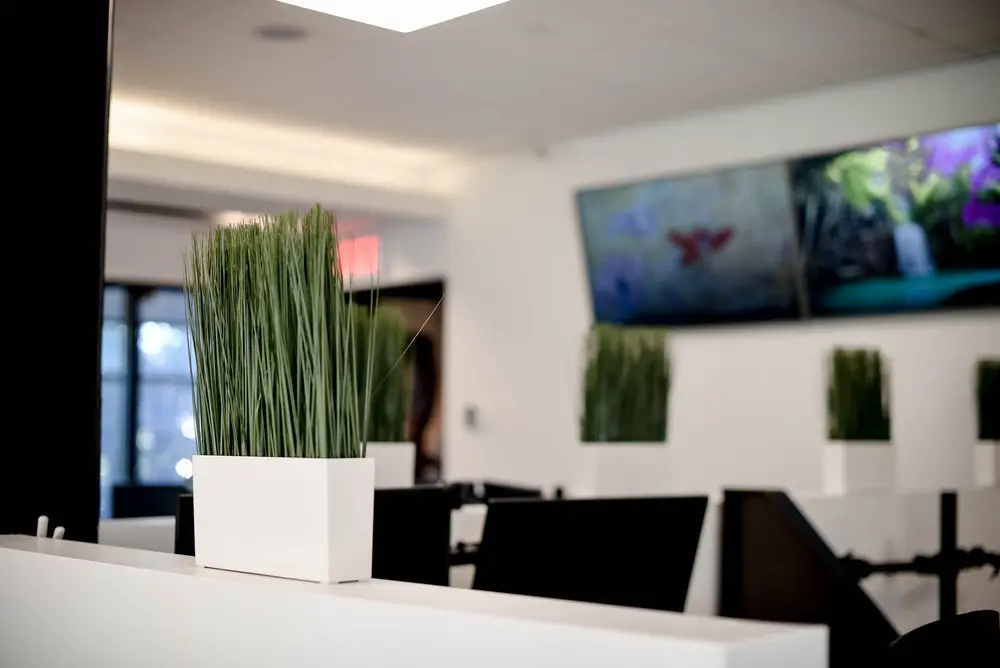
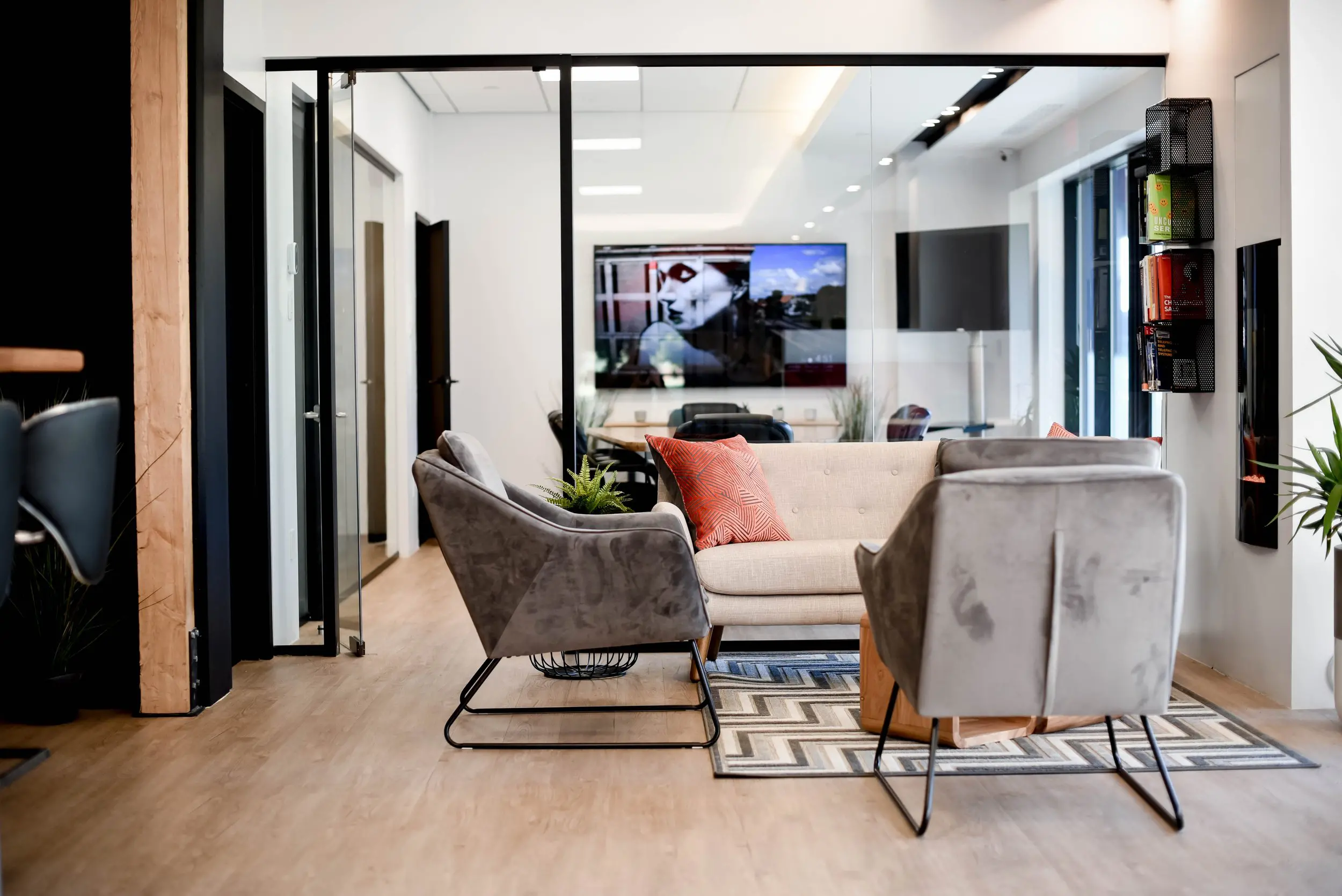
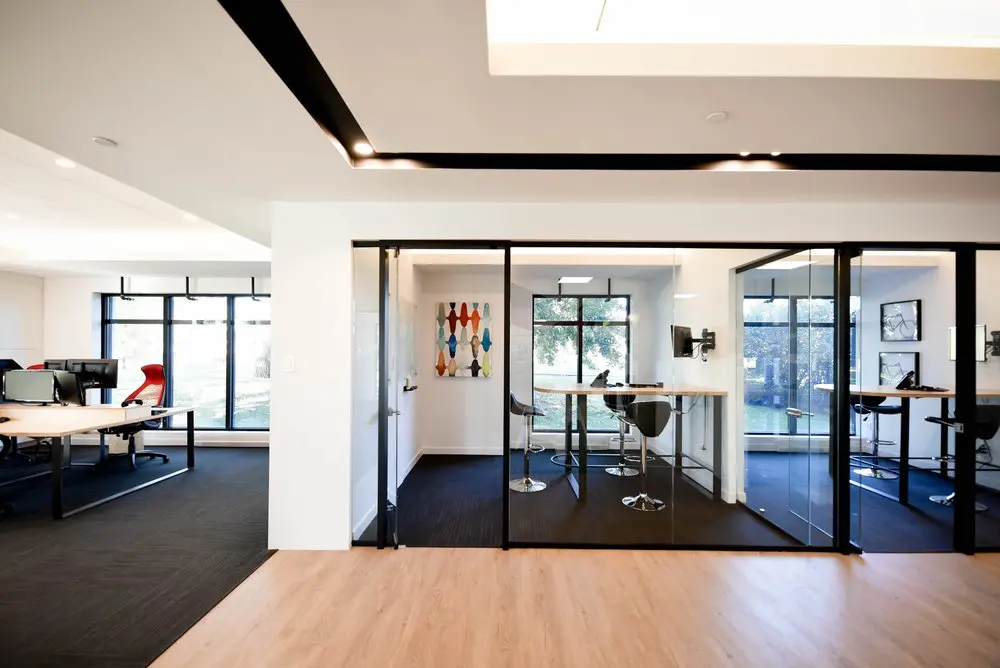
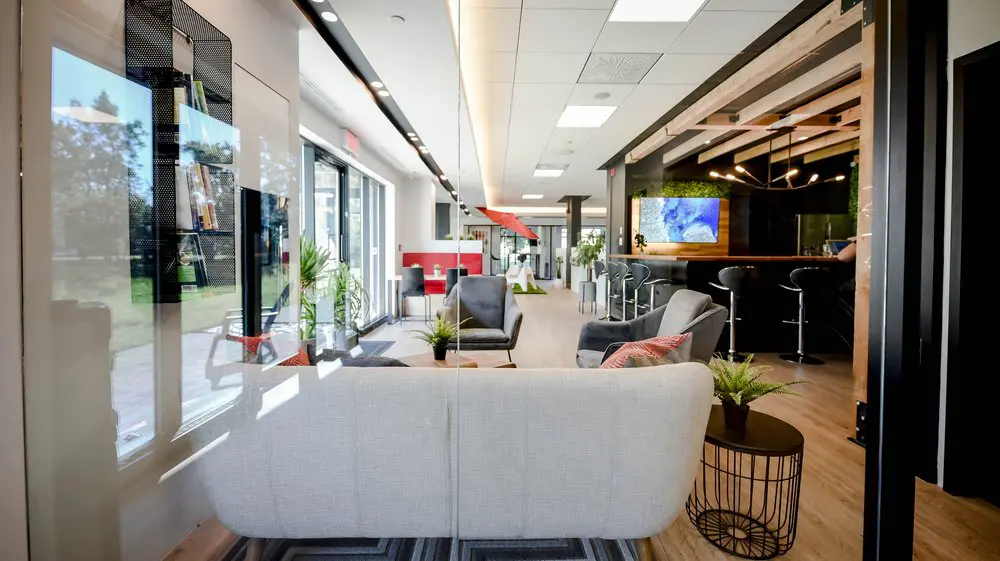
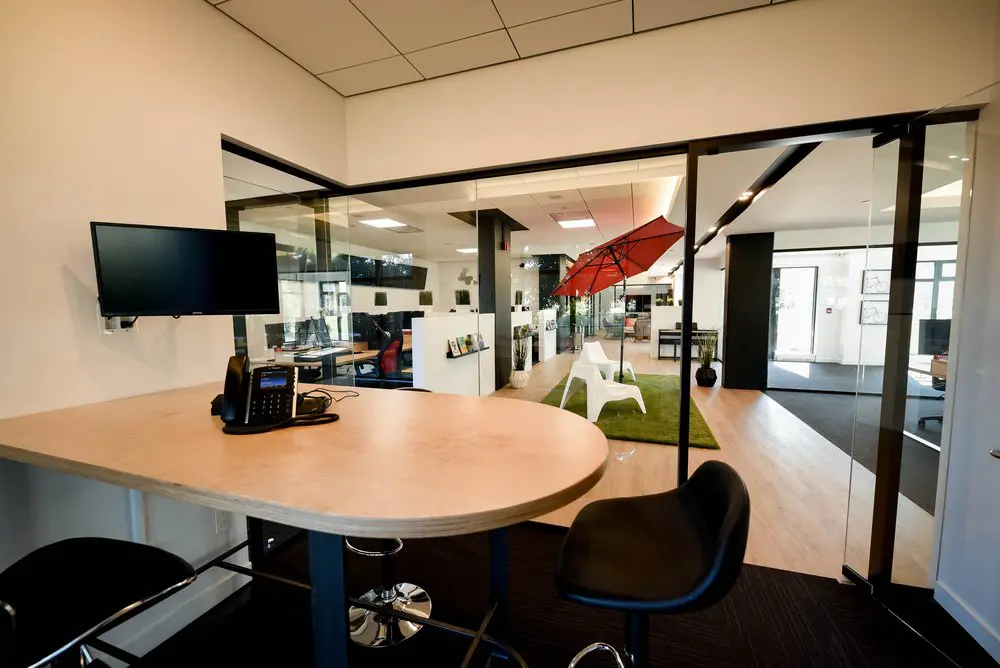
2727 Coworking space, 2727 Saint-Patrick, Montreal
Why One Month Is the Hardest Term to Buy
Every workspace product is priced around an expected stay. An operator who furnishes an office, programs access credentials, runs a credit check, prepares an agreement, issues keys and cleans the room after departure spends roughly the same effort whether the occupant stays four weeks or four years. Spread over a long stay, that cost disappears into the monthly rate. Concentrated into a single month, it either shows up as a separate fee or it gets built into a higher short-term price. Industry pricing guides describe both patterns. Upflex's July 2026 guide puts the month-to-month premium at 15 to 25% over an annual commitment and flags separate activation fees of $100 to $500 [30]. CoworkingCafe's April 2026 analysis illustrates the same premium with a 12-month seat at $200 against $240 month to month [31]. Both sources are written for a North American audience rather than Montreal specifically, so treat the percentages as a pattern, not a local quote.
The second reason is vacancy risk. A private office that is booked for one month may sit empty the month after, because most office seekers want to start on the first of a month and stay. An operator who accepts a four-week booking in the middle of a quarter may lose a longer tenant who wanted that room. That is why many operators either decline very short office stays, set a minimum term, or price them so that the operator is indifferent.
The third reason is the market itself. Montreal's conventional office market has plenty of space, but it is space sold on long terms. Cushman & Wakefield reported that "Overall office vacancy in the GMA edged up to 17.9% in Q2 2026" [28], while Altus Group reported that "Montreal's office availability rate contracted by 130 basis points to 16.4%" in its Q2 2026 update dated September 1, 2026 [29]. High availability does not translate into one-month leases: Quebec commercial leases are described as "generally ranging from three to five years" [27], and a Quebec property-management firm writing in April 2026 notes that initial terms of three to ten years are common [7]. The supply that can actually be rented for a month is the flexible segment: coworking, executive suites and hourly platforms.
Demand for short stays is real and steady. Statistics Canada reported that "About 1 in 10 (9.8%) workers had a hybrid work arrangement in May 2026" [43]. Add consultants on a Montreal mandate, companies between leases, renovations at home, visiting teams and founders testing the city, and the result is a constant flow of people who need a door that closes for a few weeks.
The Six Short-Stay Options in Montreal
Each option below sells a different thing. Before comparing prices, compare what you are actually buying: a right to a specific room, access to a building, an hourly booking, or a transfer of someone else's lease.
1. Coworking private office
A coworking private office is a furnished, lockable room inside a shared workspace, with internet, common areas and usually meeting rooms in the same building. It is the closest thing to "an office for a month" that the market sells, because the furniture, connectivity and reception are already in place.
Published Montreal prices in October 2026 include:
Montréal CoWork (Plateau Mont-Royal): private office "À partir de 705$ /mois/poste +txs", dedicated desk "À partir de 450$ /mois/poste +txs", flexible desk "À partir de 275$ /mois/poste +txs" and day pass "À partir de 30$ /jour +txs" [15]. Note the basis: per workstation (poste), not per room.
Halte 24-7: Montreal private offices "Ranging between $850 and $2200/ month", dedicated desks "Starting from $399/month" and hotspot desks "Starting from $249/month" [17].
WeWork Montreal: day pass "from C$54/day", coworking membership shown as "from C$479/mo C$408/mo" (a reduced price displayed beside the regular one), private office "Inquire for pricing" [14].
Aggregated data on one directory: private offices "from $315 excl. tax" per month and half of the spaces below $365 per month for a desk, across the 12 Montreal spaces it tracks [18].
None of these pages states a minimum term for private offices. That silence is normal; it is also why you must ask. The coworking private office is usually the best short-stay option when you need the same room every day, a professional setting for visitors and no setup work.
2. Executive suites and serviced offices (IWG, Regus, Spaces and similar)
Executive suites are coworking's older sibling: private offices in a managed centre with reception, mail handling and meeting rooms, usually sold under a standard service agreement. IWG operates the Regus and Spaces brands; a directory of Montreal spaces notes that Regus operates the largest network among the spaces it tracks [18]. A broker listing page headed "30 Serviced Offices Available in Montreal" advertises serviced offices "Starting from CA$315 per desk / month" [19], although the same page's body text cites higher starting points (a minimum monthly price of $348, and CA$550 per desk a month), so treat the headline as a floor rather than a typical price. Headline "from" prices in this segment are often tied to longer contracts, so ask what the price is for the exact term you want.
The IWG global terms (dated 2026) are worth reading even if you never sign with IWG, because they show how a short agreement is engineered:
No lease. "AN AGREEMENT CREATES NO TENANCY INTEREST, LEASEHOLD ESTATE OR OTHER REAL PROPERTY INTEREST IN YOUR FAVOUR WITH RESPECT TO THE ACCOMMODATION" [13].
Automatic renewal. Agreements "WILL RENEW AUTOMATICALLY FOR SUCCESSIVE PERIODS EQUAL TO THE CURRENT TERM", periods "SHALL RUN TO THE LAST DAY OF THE MONTH IN WHICH THEY WOULD OTHERWISE EXPIRE", and month-to-month agreements "ARE SUBJECT TO A CHANGE IN FEES ON EACH RENEWAL" [13].
Notice. For month-to-month: "no less than 1 months' notice from the 1st day of any calendar month"; for a 3-month term: "no less than 2 months' notice prior to the end of the term" [13].
Retainer. A service retainer or deposit is held "without generating interest" and processed "within 30 days" after the agreement ends; if you do not set up automatic payment, a "payment retainer equal to one times your monthly product fee" applies [13].
Activation and exit fees. "An activation fee is payable in respect of each agreement", and on departure a "fixed office restoration service fee" applies, with the amount set by country in the House Rules [13].
Prorating. "Where a daily rate applies, the charge for any such month will be 30 times the daily fee. For a period of less than a month the fee will be applied on a daily basis" [13].
For a one-month stay, the practical consequence is that the headline monthly price is only one of five numbers you need: the monthly fee for your term, the activation fee, the retainer, the restoration fee and the date your notice takes effect. For a longer comparison of this category against sublets and managed offices, see Managed Office vs Sublease vs Executive Suite.
3. Day offices and hourly private offices
If your need is a private room on certain days rather than every day, booking platforms sell enclosed offices by the hour or the day. In October 2026, LiquidSpace showed a Regus private office in Anjou at "CAD $23/hour" for one person and "CAD $104/hour" for nine people, and another Montreal provider at "CAD $60+/hour" for two people [20]. A closed one-person office in a converted factory on Rue Saint-Ambroise in Saint-Henri was listed at "CAD $100/day-pass" [21].
Day offices are the cleanest answer to "two or three days a week for a month". Twelve days at $100 is $1,200 before tax, with no setup fee, no deposit and no notice. They are a poor answer when you need to leave equipment overnight, receive mail, or be sure the same room is free on the day you need it. Our guide on hourly vs daily workspace covers the break-even between hourly and daily booking units.
4. Sublets of someone else's office
Businesses with more space than they need sometimes sublet a room or a whole suite. Montreal has a dedicated downtown platform: the Chambre de commerce du Montréal métropolitain's Espaces et cie describes itself as "le site des annonces, des afficheurs et des chercheurs d'espaces à bureaux du centre-ville de Montréal", with "des espaces autonomes et à partager, en location et en sous-location" [26]. On general classifieds, the Greater Montreal office-sublet category on Kijiji showed 16 listings on October 3, 2026, with posted prices from $380 to $2,550 a month. Most were direct office rentals in Laval, Longueuil, Saint-Laurent and the suburbs rather than true sublets; the one listing labelled a sublet offered two furnished rooms on Boulevard Décarie in Saint-Laurent at $2,300 a month [25]. Classified listings change daily.
A sublet can be the cheapest private room per month, but three legal facts limit it for short stays. First, the tenant who sublets must notify the landlord and obtain consent, and the landlord may not refuse "without a serious reason" (Civil Code articles 1870 and 1871) [1]. Second, those rules can be displaced by contract: Éducaloi notes that "A commercial lease can stop a tenant from subletting or assigning their lease" [2]. Third, the person subletting to you can give you no more than they have: if their lease ends or is terminated, your sublet ends with it. Ask to see the head lease clause on subletting and the landlord's written consent before you pay anything.
5. A short-term commercial lease, directly from a landlord
Signing a commercial lease for one to three months is legally possible: the Civil Code allows a lease with a fixed term, and Hopem notes that "the term of a commercial lease is generally negotiated between the parties; there is no strict legal rule that imposes it" [7]. In practice it is rare, because the landlord bears the same leasing costs as for a five-year tenant and the space usually comes empty. Expect a security deposit ("The landlord of a commercial space can ask the tenant for a security deposit") [2], possibly additional rent for operating costs and taxes under a net lease [27], and your own furniture, internet and insurance.
There is also an administrative step that a coworking member rarely thinks about. The City of Montreal says you must get an occupancy permit, "also called a certificate of occupancy, to conduct a commercial or industrial activity in a building for purposes other than housing" [12]. Fees and processing times vary by borough, and the French version of the page cites six to eight weeks of analysis once a file is complete [47]. For a one-month stay, that timeline alone can rule out a direct lease. Whether a permit is needed when you are a member inside an operator's centre, rather than a tenant of your own premises, is a question for the borough and the operator; do not assume either way.
6. Hotel day rooms
Day-use hotel bookings sell a room for a block of hours, typically during business hours. In October 2026, Dayuse advertised Montreal day rooms "from $75", including Hyatt Place Montreal Downtown at CA$129 for 9 a.m. to 5 p.m. and Le Nouvel Hotel at CA$119 [24]; another Dayuse page listed Chateau Versailles at CA$94 and Sofitel Montréal Golden Mile at CA$269 for day use [45].
A hotel room is private and bookable at short notice, which makes it useful for a confidential call, an interview or a travelling consultant who needs a base for a few days. It is not designed as an office: desks are small, guests may not be allowed, and the Wi-Fi is shared with guests. Quebec's lodging tax is also worth knowing. Revenu Québec's brochure describes it as 3.5% of the price of the night, applying to a unit rented "pour plus de 6 heures au cours d'une période de 24 heures" in regions whose tourism association has requested it [41], and a 2017 government release confirms the 3.5% rate "pour l'ensemble des régions touristiques où elle s'applique" [42]. The brochure dates from 2016 and says it is not a legal interpretation, so check the booking total before you pay. An eight-hour day block is longer than six hours.
Options at a glance
Option
What you buy
Typical short-stay unit
Montreal price evidence (October 2026, before taxes)
Usual legal form
Lead time
Coworking private office
A furnished lockable room plus shared amenities
Month, sometimes with minimum
From $705/month per workstation [15]; $850 to $2,200/month per office [17]
Membership or service agreement; sometimes a lease
2727 Coworking space, 2727 Saint-Patrick, Montreal
Anatomy of a One-Month Bill
The table that matters for a short stay is not the rate card; it is the list of everything that appears on the first and last invoices. Here are the lines to expect, what they mean and how they behave when the term is short.
The monthly fee for your actual term
Many operators publish a "from" price that belongs to their longest or most popular commitment. Ask for the price at your exact term. If a 12-month price is $1,000, a month-to-month price of $1,150 to $1,250 is consistent with the 15 to 25% premium described in industry guides [30]. Check also whether the price is per room or per person: Montréal CoWork quotes per workstation [15], so a three-person office at "from $705" is not $705.
Setup, activation or onboarding fee
A one-time fee to open the account, issue credentials and prepare the room. It is usually non-refundable. DeskWorks, which writes for coworking operators, notes that some operators replace deposits with non-refundable setup fees and contract language covering damages and early termination [32]. IWG charges an activation fee "in respect of each agreement", and the fee "covers the administrative cost of the client onboarding process and account setup" [13].
The size varies enormously, from about a hundred dollars to a full month's fee. This single line explains most of the "why does checkout show an extra month?" confusion. When an online checkout for a monthly office shows two months on the first charge, the second month is often a setup fee equal to one month's rent, not a prepaid last month and not a deposit. Those are three different things with three different refund rules, so ask which one it is:
A refundable amount held against damage and unpaid invoices. DeskWorks writes that "It's quite common to charge one month's membership fee for the space as a security deposit", while observing that hot desks and drop-in access often do not warrant one [32]. Commercial landlords may ask for one too, unlike residential landlords [2].
On a one-month stay, a deposit is cash tied up rather than cost, but it matters for two reasons. The refund often arrives weeks after you leave (IWG says "within 30 days") [13], and the refund conditions decide whether it really comes back. On taxes, the CRA instructs businesses: "Do not collect the GST/HST when a customer gives you a deposit towards a taxable purchase. Collect the GST/HST on the deposit when you apply it to the purchase price", and a forfeited deposit becomes taxable [36]. If tax is charged on a deposit at the moment you pay it, ask why.
Key, fob and access-card deposits
A refundable deposit per key, fob or remote. These are small next to rent but scale with headcount: three people at $75 each is $225 that you must remember to return. Ask whether the deposit is refunded automatically on return or deducted from a final invoice.
Prorating, start dates and calendar months
Short stays rarely start on the first. Three billing conventions are common:
Calendar months, prorated. You pay the days left in the starting month, then full calendar months. IWG states that for a period of less than a month "the fee will be applied on a daily basis", and a month at a daily rate is "30 times the daily fee" [13].
Date-to-date months. A month runs from the 15th to the 14th. No prorating, and a one-month stay is exactly one fee.
Calendar months, no prorating. Starting on the 20th costs a full month for eleven days. Avoid this for a short stay or negotiate the start date.
The convention interacts with renewal. If periods "run to the last day of the month" and renew automatically, as in the IWG terms [13], a stay that begins mid-month can produce a prorated stub, a full month and, if notice is late, a further month.
Notice periods: the hidden second month
Notice is the clause that most often turns one month into two. A month-to-month agreement is not the same as a one-month agreement: month to month means it continues until someone ends it, and ending it takes notice. CoworkingCafe reports that "Most coworking operators require 30 to 90 days' written notice before cancellation takes effect" and warns that many agreements auto-renew at the end of the initial term, sometimes at a higher rate [31]. If you sign on the 1st and must give 30 days' notice effective at the end of a calendar month, giving notice on the 2nd still carries you to the end of the following month in many contracts.
The fix is simple and should be written into the agreement: a fixed start date and a fixed end date, with a statement that the agreement ends on that date without notice. If the operator only offers month to month, give notice on the first day, in the channel the contract requires (IWG, for example, requires notice "THROUGH YOUR ONLINE ACCOUNT OR THROUGH THE APP") [13], and get a written confirmation of the end date. Our notice period guide covers the timing in both directions.
Taxes: GST and QST
In Quebec, a business supply of office space or workspace services is normally taxable at 5% GST and 9.975% QST. The federal Excise Tax Act sets GST "at the rate of 5% on the value of the consideration for the supply" [34], and the Act respecting the Québec sales tax sets QST "at the rate of 9.975% on the value of the consideration for the supply" [35]. The CRA's rate table lists Quebec at 5% and 9.975% [33]. Both apply to the same pre-tax price, so the combined rate is 14.975%; the QST Act itself refers to that combined 14.975% figure for registrants computing both taxes together [35].
Two consequences for short stays. First, taxes apply to the setup fee too, so a "one month plus setup" invoice for a $1,000 office is $2,299.50, not $2,000. Second, a business registered for GST and QST can usually recover them: the CRA explains that registrants "recover the GST/HST paid or payable on your purchases and expenses related to your commercial activities by claiming input tax credits" [37], and the QST Act provides the parallel input tax refund [35]. A small supplier under the $30,000 threshold who has not registered cannot claim them [38]. For an unregistered freelancer, the tax is a real cost; for a registered company, it is mostly cash flow. Ask your accountant which applies to you.
Everything else
Meeting-room hours beyond any included allowance, printing, guest passes, after-hours access, phone booths, parking and cleaning at exit are all priced differently by operator. The move-in costs guide lists them in detail. For a one-month stay, the relevant question is only which ones you will actually use in four weeks.
The Arithmetic of a Short Stay
One-time charges matter in proportion to how few months they are spread over. The table below takes an illustrative office at $1,000 a month before taxes, with a non-refundable setup fee equal to one month, and shows the effective monthly cost by length of stay. It assumes daily prorating for the two-week case, which not every operator offers.
Length of stay
Rent
Setup fee
Total before tax
Effective cost per month
Total with GST + QST (14.975%)
2 weeks (prorated)
$500
$1,000
$1,500
$3,000
$1,724.63
1 month
$1,000
$1,000
$2,000
$2,000
$2,299.50
2 months
$2,000
$1,000
$3,000
$1,500
$3,449.25
3 months
$3,000
$1,000
$4,000
$1,333
$4,599.00
6 months
$6,000
$1,000
$7,000
$1,167
$8,048.25
12 months
$12,000
$1,000
$13,000
$1,083
$14,946.75
The same office costs twice its rate card for a one-month stay and only 8% more over a year. Now add the notice problem: if a late notice adds one more month, the one-month stay becomes $3,000 before tax, or three times the advertised price. This is why the term on paper matters more than the headline price for anyone staying less than a quarter.
Compare that with the same need met by other units. If you actually need a private room on 12 working days in the month, a $100 day office costs $1,200 before tax [21], with no setup fee and no notice. If you need it on 21 working days, the same day rate costs $2,100, about the same as the one-month office with a setup fee, but without the risk of a second month.
2727 Coworking space, 2727 Saint-Patrick, Montreal
Lease or Service Agreement? What the Civil Code of Québec Says
You will be asked to sign something called a membership agreement, an office service agreement, a licence or a lease. The name on the cover does not settle which rules apply, but it is the starting point. This section is general information, not legal advice; for a significant commitment, ask a lawyer or notary to read the document.
What a lease is
Article 1851 of the Civil Code defines it: "Lease is a contract by which a person, the lessor, undertakes to provide another person, the lessee, in return for a rent, with the enjoyment of movable or immovable property for a certain time. The term of a lease is fixed or indeterminate" [1]. The key words are "enjoyment" of property "for a certain time". Under article 1854, the lessor must deliver the property "in a good state of repair" and provide "peaceable enjoyment of the property throughout the term of the lease"; under article 1855, the lessee is bound "to pay the agreed rent and to use the property with prudence and diligence" [1].
For commercial premises, those rules mostly serve as defaults. Gowling WLG summarizes: "The provisions of the CCQ apply to commercial leases if and to the extent that they are not contracted out of by the parties" [5]. Hopem adds that the "absence of a specific regime allows for greater contractual freedom between the parties" [7], and Stikeman Elliott notes that the relationship is governed "not just by the terms and conditions of the lease agreement itself but also by certain provisions of the Civil Code of Québec" [6]. The Gowling and Stikeman articles are older (2012 and 2009); the Code articles they describe are unchanged in the current text quoted here.
What a service agreement is
Article 2098 defines the contract of enterprise or for services: a person "undertakes to another person, the client, to carry out physical or intellectual work or to supply a service, for a price which the client binds himself to pay to him" [1]. A coworking membership that sells access to shared areas, internet, reception, cleaning and meeting rooms, with the operator keeping control of the premises and the right to assign you a room, looks more like a bundle of services than like the enjoyment of a defined space. That is exactly the line the IWG terms draw when they say each centre "remains in Our possession and control" and the agreement creates "NO TENANCY INTEREST" [13].
A private office with your own key, used exclusively for a fixed period at a monthly price, may sit closer to a lease, whatever the document calls itself. The Code tells a court to look for "the common intention of the parties rather than adherence to the literal meaning of the words", taking into account the nature of the contract, the circumstances in which it was formed and how the parties have already interpreted it (arts. 1425 and 1426) [1]. We found no published Quebec decision applying these rules to a coworking membership or a business-centre agreement, so the classification of any particular agreement is genuinely uncertain. If the distinction matters to you (because you want the protections of one regime or the flexibility of the other), have the agreement reviewed.
Why the distinction matters for a short stay
Question
If it is a lease
If it is a service agreement
Can I end it early?
A fixed-term lease "terminates by operation of law upon expiry of the term"; ending earlier needs the lessor's agreement or a contract clause (art. 1877) [1][3]
The client "may unilaterally resiliate the contract" (art. 2125), paying for services already provided and costs, and answering for other injury (art. 2129) [1]. Agreements often limit this right with notice periods or exit fees, and how far such limits hold between businesses is a question for a lawyer
What if I stay past the end date?
Tacit renewal after more than 10 days, for one year or for the initial term if shorter (art. 1879) [1]
Whatever the contract's holdover or auto-renewal clause says
Notice for an open-ended arrangement
Equal to the rent payment period, or three months if that period exceeds three months (art. 1882) [1]
Whatever the contract says, subject to the rules on adhesion contracts
Can I sublet or transfer?
Yes with notice and consent, which may not be refused without a serious reason, unless the lease validly prohibits it (arts. 1870, 1871) [1][2]
Usually not; memberships are typically personal
Can the provider move me?
Not without breaching peaceable enjoyment of the leased premises, unless agreed
Often yes, if the agreement allows it (IWG reserves the right to "allocate different accommodation" of "reasonably equivalent size", with advance notice) [13]
Who hears a dispute?
Court of Québec or Superior Court; the TAL "only hears conflicts relating to residential leases" [2]
Civil courts
The tacit renewal trap
Article 1879 deserves its own paragraph because it is written for exactly the short stay. "A lease is renewed tacitly where the lessee continues to occupy the premises for more than 10 days after the expiry of the lease without opposition from the lessor. In that case, the lease is renewed for one year or for the term of the initial lease, if that was less than one year, on the same conditions" [1]. Article 1878 confirms that renewal of a lease of an immovable "may be tacit" [1], and Éducaloi summarizes the rule for commercial tenants: the lease is automatically renewed if "10 days have gone by since the end of the lease, and the landlord has not asked the tenant to leave the premises" [3]. Gowling describes the same rule for commercial leases [5].
For a one-month lease, the renewal period is one month, which may be welcome or not. For a six-week sublet, it could be six weeks. Because commercial parties can contract out of many Code rules [5], many leases exclude tacit renewal expressly. Either way, plan the move-out date, and if you need a few extra days, agree them in writing.
You are not a consumer, but you are not unprotected
Quebec's Consumer Protection Act defines a consumer as "a natural person, except a merchant who obtains goods or services for the purposes of his business" [8], and the Office de la protection du consommateur puts it bluntly: "Une entreprise n'est jamais considérée comme un consommateur" (a business is never considered a consumer) [9]. A company or freelancer renting an office for work is therefore outside the consumer regime, and the TAL has jurisdiction only over dwelling leases [46].
What remains is the Civil Code's protection for contracts of adhesion, which applies to businesses too. A contract is of adhesion when its essential stipulations "were imposed or drawn up by one of the parties ... and were not negotiable" (art. 1379) [1]. Standard online memberships usually fit that description. In such contracts:
an external clause (for example "house rules" on a separate web page) is null if it was not expressly brought to your attention at formation (art. 1435);
an illegible or incomprehensible clause is null if you suffer injury from it, unless adequately explained (art. 1436);
an abusive clause, one that is "excessively and unreasonably detrimental" to the adhering party, is null or reducible (art. 1437);
a penalty (such as an early-exit fee) "may be reduced if the creditor has benefited from partial performance of the obligation or if the clause is abusive" (art. 1623);
no one may exclude liability for material injury caused by intentional or gross fault, or for bodily or moral injury (art. 1474) [1].
These are remedies after the fact. The practical protection is reading the agreement, including linked house rules, before you pay.
Language of the contract
Section 55 of the Charter of the French language provides that contracts of adhesion and related documents "must be drawn up in French", and the parties "may be bound only by its version in a language other than French if, after its French version has been remitted to the adhering party, such is their express wish" [10]. Norton Rose Fulbright's summary explains that contracts of adhesion and contracts with printed standard clauses must be in French but may be in English "at the express wish of the parties" [11]. In practice, a Quebec operator should offer you the French version first. If you prefer English, you will usually confirm that choice in writing.
What a Short-Term Office Agreement Should State
Whatever its legal label, a short agreement should answer these questions on paper. Use this list when you receive a draft.
Parties. Your legal name (company or individual) and the operator's legal name, as they will appear on invoices.
The space. The specific office number, its capacity, and whether it is guaranteed or can be substituted.
Start date and end date. Both as calendar dates. State whether the agreement ends automatically on the end date or continues until notice.
Renewal. Whether it renews, for how long, at what price, and how to stop it.
Notice. The length, the channel (email, portal, app) and the effective date rule (any day, or first of the month).
Every charge, itemized. Rent or fee for the term, setup or activation fee, deposit or retainer, key or fob deposits, restoration or cleaning fee, and the tax treatment of each.
Prorating. How a partial month is calculated.
Deposit refund. Conditions, deductions and the date by which it is returned.
Access. Hours, days, holidays, and whether access cards work outside staffed hours.
Included services. Internet, furniture, cleaning, meeting-room time, printing, mail, coffee, and anything you specifically need (a monitor, a lockable cabinet, a phone booth).
Use of the address. Whether you may use it on letterhead, a website or a government registration. Our business address guide explains what registries accept.
Guests and deliveries. Who may visit and whether parcels are accepted.
Relocation and closure. Whether the operator may move you, and what happens if the space becomes unusable.
Early exit. Whether you can leave early and what it costs.
Holdover. What happens if you stay a few days longer.
Insurance and liability. Whether you must carry insurance; see our insurance guide.
Property left behind. What happens to items left after the end date.
Language. The French version and, if you want it, your express choice of English.
Cancellation before the start date. What you get back if your plans change before move-in.
If an operator will not put a date-to-date term in writing, treat the agreement as month to month and plan for the notice period. Our longer guide includes an 18-point negotiation agenda for short offices that complements this list.
2727 Coworking space, 2727 Saint-Patrick, Montreal
Negotiation Tips for a Few Weeks or a Month
Short stays have less leverage than long ones, but they have some. Montreal's office availability of 16.4% in Q2 2026 [29] signals that conventional space is not scarce, although availability in a given coworking building can be tight. Operators with an office that has been empty for weeks may prefer a short paying stay to nothing, especially in quieter months. Here is what tends to work.
Ask for the term you need in writing, not a discount. A fixed end date with no notice is worth more than 10% off a month-to-month price that drags you into a second month.
Trade the setup fee against something. Offer to prepay the full stay, accept a less popular office, or start on a date the operator needs filled. Some operators waive or reduce setup fees on longer prepaid terms; ask whether yours does.
Ask whether a deposit can replace a non-refundable fee. A refundable deposit costs you nothing if you leave the room in good order.
Negotiate the start date. On calendar-month billing, starting on the 1st avoids a prorated stub; on date-to-date billing, start when you are ready.
Ask for a credit if you stay longer. If there is a chance you will stay, ask that the setup fee or a short-stay premium be credited against a longer commitment signed within a defined period.
Bundle what you will actually use. If you need a meeting room twice, ask for those hours to be included rather than paying an hourly rate.
Check the per-person basis. For two or three people, a price quoted per workstation can exceed a price quoted per room. Montréal CoWork, for example, quotes "par poste" [15].
Use the off-season. Quieter months can give you more room to negotiate a short stay; ask whether any office has been empty for a while.
Get the total in one sentence. Ask: "What will I pay in total, including taxes, from my first day to my last day, assuming I leave on [date]?" Write the answer into the agreement or confirmation email.
Never negotiate the law away by accident. A clause excluding tacit renewal or setting a holdover rate protects both sides; a clause letting the operator change the fee at each renewal (IWG's month-to-month agreements are "SUBJECT TO A CHANGE IN FEES ON EACH RENEWAL") [13] is acceptable for a long stay but worth noting for a short one.
Cost Comparison: One Person, One Month of Private Work
The table below compares realistic ways to get a private or semi-private place to work for one person over one month of 21 working days. Prices are public listings as of October 2026; fees are illustrative where the operator does not publish them. Taxes are calculated at 14.975% where the listing is before tax.
$380 to $2,550/month posted in Kijiji's sublet category (mostly direct rentals) [25]
Varies
Varies
Usually yes
Landlord consent; furnishing and internet vary
Three conclusions follow. For a full month of daily private work, a coworking office without a setup fee is usually cheapest, and one with a one-month setup fee is roughly equal to booking a day office every day. For part-time private work, day offices win clearly. And if privacy is needed only for calls, a day pass or hot desk plus occasional meeting-room bookings costs a fraction of any office.
2727 Coworking space, 2727 Saint-Patrick, Montreal
When a Day Pass, Dedicated Desk or Meeting Room Is the Smarter Choice
Many people asking for "an office for a month" need privacy for part of the day, not a room for the whole month. Before you commit, test your need against these rules.
Choose a day pass when
you will work on site fewer than about three days a week;
your calls are routine and can be taken in a phone booth, a meeting room or with a headset;
you do not need to leave equipment overnight.
Published Montreal day passes start around $30 to $54 a day, and one directory puts the median near $64: Montréal CoWork from $30 [15], WeWork from C$54 [14], and a directory reporting half of its spaces below $64 [18]. A June 2026 roundup cites Montréal CoWork at "30 $ pour une journée, 275 $ pour un mois et 230 $ pour un carnet de 10 séances de travail valide 3 mois" [44], the kind of pass pack that suits an irregular few weeks. See Day Pass vs Monthly Hot Desk for the break-even.
Choose a dedicated desk when
you will be there most days and want the same seat, a monitor and a place to leave things;
confidentiality of conversations is not critical;
the monthly desk price plus any one-time fee is well below a private office.
Published dedicated desks in Montreal start around $399 to $450 a month [17][15]. The same fee and notice questions apply as for offices.
Choose a meeting room when
the private need is a set of specific events: interviews, client meetings, a workshop, a board meeting;
you need space for several people for a day rather than a room for one person for a month.
Montreal meeting rooms on WorkIn run from $251 to $754 a day before tax, median $340, with hourly rates from $45 and half days from $143 [23]. Deskpass lists Montreal rooms from CA$30 an hour, with the most expensive at CA$170 an hour [22], and Montréal CoWork lists meeting rooms "À partir de 25$/h +txs" [16]. Four meeting days at $340 is $1,360 before tax, often less than a month of a private office for a team.
Choose a private office when
you need the same enclosed room every day, for confidential calls or work;
you will keep equipment or documents on site;
you receive visitors who should see a closed door with your name on it.
A quick decision table
Your need over the next few weeks
Best fit
Why
1 to 2 days a week, mostly focused work
Day pass or pass pack
No commitment; pay per day
1 to 2 days a week, private calls
Day office or meeting-room hours
Privacy only when needed
3 to 5 days a week, no confidential calls
Hot or dedicated desk
Lower monthly cost
3 to 5 days a week, confidential work
Private office
Daily privacy and storage
A few client meetings or interviews
Meeting room by the day or hour
Pay for the event only
A visiting team for a week
Meeting room daily, or several day passes
A month of office is too long
Waiting for a lease to start
Private office with a fixed end date
Bridge with a known exit
A Planning Timeline for a Short Stay
Three to four weeks before: list the days you need privacy, the headcount and any equipment. Decide between office, desk, day office or meeting room using the table above.
Two to three weeks before: request written quotes that state the total for your exact dates, including taxes. Tour if you can.
One to two weeks before: read the agreement and house rules. Confirm the end date or give notice in the required channel as soon as the agreement starts.
Move-in day: sign for keys and fobs; note their number and deposit.
Last week: confirm the move-out date in writing, book any exit cleaning, collect your belongings.
After you leave: return keys, keep a receipt, and diary the date the deposit should come back.
2727 Coworking space, 2727 Saint-Patrick, Montreal
Accounting for a Short-Term Office
For an operating business, short-term office rent is generally a deductible expense. The CRA says: "You can deduct rent incurred for property used in your business" [39]. If you prepay across a year-end, the CRA's rule is to "Claim the expense you prepay in the year or years in which you get the related benefit" [40]. Deposits are not expenses until forfeited or applied. Registered businesses usually recover GST and QST through input tax credits and refunds [37]. These are general rules; confirm your treatment with your accountant.
How 2727 Coworking Fits
2727 Coworking is a coworking space in Griffintown. For a short stay, these are the pricing rules we can state as of October 2026:
Taxes are extra. Our prices are before taxes; GST (5%) and QST (9.975%) are added, 14.975% in total. Live prices are at booking.2727coworking.com.
Why online checkout shows an extra month. Online checkout for a month-to-month private office adds a setup fee equal to one month's rent (hot desks and dedicated desks have none). It is a setup fee, not a deposit and not a prepaid last month.
Longer terms cost less. Annual prepayment is 10 months charged for 12, and a 12-month lease is 5% off the monthly rate.
Key fob deposit. $75 per fob.
Term. Terms for offices and desks are set per agreement. If you are planning a stay of a few weeks or a month, contact us or book a tour and ask before you check out.
If a private office is more than you need, the day pass and desks page and the conference room may cover your need. If nothing suitable is free when you need it, the waitlist notifies you when it is.
2727 Coworking space, 2727 Saint-Patrick, Montreal
Frequently Asked Questions
Can I rent a private office in Montreal for just one month?
Yes, some providers offer it, but few publish it. Coworking spaces and executive suites are the realistic sources; conventional landlords usually want three to five years [27]. Ask each provider for the price, minimum term and notice for exactly one month, and get the end date in writing.
Can I rent an office for two weeks?
Sometimes. Providers that prorate by the day, as the IWG terms describe for periods "of less than a month" [13], can bill two weeks, but one-time fees still apply in full. For two weeks, ten bookings of a day office at around $100 a day [21] are often simpler and cheaper.
Is there a weekly office rate in Montreal?
Weekly rates are uncommon on public price lists. The practical substitutes are daily private offices, hourly offices from about $23 an hour [20], or day passes for a week. Ask an operator directly; some will quote a week on request.
Can I rent a private office by the day or by the hour?
Yes, through booking platforms and some operators. Examples in October 2026 include $23 an hour for a one-person Regus office in Anjou [20] and $100 a day for a closed office in Saint-Henri [21]. See our private day office guide.
What is the usual minimum term for a coworking private office?
There is no standard. Some operators sell month to month, some require three, six or twelve months, and many do not publish it. Under the IWG terms, a 3-month agreement needs "no less than 2 months' notice prior to the end of the term" [13]. Always ask for the minimum and the notice together.
Why does checkout show an extra month?
Usually because a setup fee equal to one month's rent is charged at the start. Less often it is a deposit or a prepaid last month. Ask which one it is, whether it is refundable, and whether it is applied to your final month. The comparison table in the "Anatomy of a One-Month Bill" section above shows how each behaves.
Is a setup fee the same as paying the last month in advance?
No. A setup fee pays for onboarding and is not applied to rent. A prepaid last month is rent you have already paid, so your final month is not billed. A deposit is returned if conditions are met. The cost of a one-month stay differs a lot between the three.
What do I pay up front for a short-term office?
Typically the first month's fee (or a prorated part), any setup or activation fee, any deposit or retainer, key or fob deposits, and GST and QST on the taxable items. Deposits in coworking are often one month's fee for private offices [32]. Ask for the total in writing before you pay.
Is a security deposit refundable, and is it taxed?
It is refundable on the conditions in your agreement, often weeks after you leave; IWG states "within 30 days" [13]. The CRA instructs businesses not to collect GST/HST on a deposit until it is applied to the price, and a forfeited deposit becomes taxable [36].
Are Montreal office prices quoted with or without taxes?
Almost always without. Listings commonly carry "+txs" or "excl. tax" [15][23]. Add 14.975% for GST and QST [33].
Is a coworking membership a lease under Quebec law?
Not necessarily. A lease gives enjoyment of property for a time in return for rent (art. 1851) [1]. Many memberships are drafted as service agreements and say they create no tenancy [13]. A private office with exclusive use for a fixed period may be closer to a lease, because the Code looks at the parties' common intention rather than the title (art. 1425) [1]. We found no published Quebec decision on coworking memberships, so if the difference matters to you, have a lawyer read the agreement.
Does the Tribunal administratif du logement handle office disputes?
No. The TAL "only hears conflicts relating to residential leases"; commercial lease disputes go to the Court of Québec or the Superior Court [2].
Does the Consumer Protection Act protect me when I rent an office for my business?
Generally no. The Act excludes "a merchant who obtains goods or services for the purposes of his business" [8]. The Civil Code's rules on contracts of adhesion and abusive clauses still apply (arts. 1379, 1435 to 1437) [1].
What happens if I stay a few days past my end date?
Under a lease, staying more than 10 days without the lessor's opposition can renew it for one year or for the initial term if shorter (art. 1879) [1]. Under a service agreement, the holdover or auto-renewal clause decides. Agree any extra days in writing.
How much notice do I need to give on a month-to-month office?
Whatever the agreement says. Industry practice runs from 30 to 90 days [31], and some contracts count it from the first day of a calendar month [13]. For a lease with an indeterminate term, the Civil Code ties notice to the rent payment period, up to three months (art. 1882) [1].
Are short stays prorated?
It depends on the provider. Some prorate daily, some bill date to date, and some charge full calendar months. Ask before choosing your start date.
Can I sublet an office for a month?
You can rent a sublet if the tenant offering it has the landlord's consent; a commercial lease can prohibit subletting [2]. On October 3, 2026, Kijiji's Greater Montreal office-sublet category showed posted prices from $380 to $2,550 a month, though most were direct rentals and only one was labelled a sublet ($2,300) [25]. Ask for the consent in writing.
Can I negotiate a lower price for a short stay?
You can negotiate terms more easily than price. A fixed end date without notice, a waived or credited setup fee, or a deposit in place of a non-refundable fee is often worth more than a percentage discount.
Is a hotel day room a good substitute for an office?
For a day or two of confidential work, possibly: Montreal day rooms start around $75 [24]. For a month, an office or desk is better equipped and usually cheaper, and a day slot over six hours may attract lodging tax [41].
When is a day pass smarter than a private office?
When you will be on site fewer than about three days a week and your calls are not confidential. A month of day passes at $30 to $54 [15][14] usually costs less than one month of a private office plus fees.
When is a meeting room the better choice?
When the private need is a handful of events (client meetings, interviews, a workshop). A Montreal meeting room at a median $340 a day [23] booked four times costs less than most team offices for a month.
Can I deduct the rent and recover the taxes?
Business rent is generally deductible [39], and GST/QST registrants usually claim input tax credits and refunds [37]. Unregistered small suppliers cannot claim them [38]. Check with your accountant.
Do I need an occupancy permit for a one-month office?
For premises you lease yourself for a commercial or professional activity, the City of Montreal requires an occupancy permit, with fees and delays that vary by borough [12]. Inside an operator's centre, ask the operator and the borough how this applies.
Must the contract be in French?
Contracts of adhesion must be provided in French first; you may then choose to be bound by another language version if that is your express wish (Charter of the French language, s. 55) [10].
Can I put an office on hold before deciding?
Some operators accept a short hold, sometimes against a deposit; others do not hold rooms at all. Ask how long a quote is valid. Under the Civil Code, an offer with a stated deadline cannot be revoked before it expires (art. 1390) [1], so a written quote "valid until" a date is worth asking for.
Does 2727 Coworking rent offices for a month?
Terms for offices and desks are set per agreement, so ask us before booking. What we can state about pricing: online checkout for a month-to-month private office adds a setup fee of one month's rent (hot desks and dedicated desks have none), annual prepayment is 10 months for 12, a 12-month lease is 5% off, the key fob deposit is $75, and taxes are extra. See booking.2727coworking.com for live prices.
Conclusion
A month in a private office is a perfectly reasonable thing to want, and Montreal has several ways to buy it. The trap is assuming the rate card describes the cost. For a short stay, the real price is the monthly fee for your exact term, plus every one-time charge divided by very few months, plus whatever the notice and renewal clauses add at the end, plus 14.975% in taxes. Get those four numbers in writing, insist on a fixed end date, and compare the result honestly with day offices, desks and meeting rooms. Often the best one-month office is a handful of private days.
2727 Coworking space, 2727 Saint-Patrick, Montreal
References
[1] Civil Code of Québec, CQLR c CCQ-1991, arts. 1379, 1390, 1435 to 1437, 1474, 1623, 1851, 1854, 1855, 1870, 1871, 1877 to 1879, 1882, 2098, 2125, 2129, LégisQuébec. Accessed October 3, 2026.
[2] 5 Things to Know About Commercial Leases, Éducaloi. Accessed October 3, 2026.
[3] Ending a Commercial Lease, Éducaloi. Accessed October 3, 2026.
[4] What Does the Tribunal administratif du logement Do?, Éducaloi. Accessed October 3, 2026.
[5] Commercial Leases in Québec (Part 1 of 2), Gowling WLG, October 2012. Accessed October 3, 2026.
[6] Commercial Leases and the Civil Code of Québec, Stikeman Elliott, October 2009. Accessed October 3, 2026.
[7] Laws and Regulations Governing Commercial Leases in Quebec, Hopem, April 30, 2026. Accessed October 3, 2026.
[8] Consumer Protection Act, CQLR c P-40.1, s. 1(e), LégisQuébec. Accessed October 3, 2026.
[9] Consommateur ou commerçant?, Office de la protection du consommateur (French page). Accessed October 3, 2026.
[10] Charter of the French language, CQLR c C-11, s. 55, LégisQuébec. Accessed October 3, 2026.
[11] Charter of the French language: mutual agreement contracts containing standard clauses, Norton Rose Fulbright, March 9, 2022. Accessed October 3, 2026.
[12] Get an occupancy permit for commercial, industrial or professional activity, Ville de Montréal. Accessed October 3, 2026.
[13] General Terms and Conditions (Office, Co-Working, Virtual Office, Membership), IWG plc, 2026. Accessed October 3, 2026.
[14] Coworking Space and Shared Offices in Montreal, WeWork. Accessed October 3, 2026.
[15] Coworking et bureaux privés, Montréal CoWork. Accessed October 3, 2026.
[16] Espace de travail tout inclus au Plateau Mont-Royal, Montréal CoWork. Accessed October 3, 2026.
[17] Offices, Jobs and Conference Rooms, Coworking Montreal and South Shore, Halte 24-7. Accessed October 3, 2026.
[18] Coworking spaces in Montreal, QC, workin.space. Accessed October 3, 2026.
[19] Serviced Offices in Montreal, Office Hub. Accessed October 3, 2026.
[20] Private Office Space Rental Prices in Montreal, LiquidSpace. Accessed October 3, 2026.
[21] Nuage B, Private Office for 1, LiquidSpace. Accessed October 3, 2026.
[22] Meeting Space in Montreal, QC, Deskpass. Accessed October 3, 2026.
[23] Meeting rooms for rent in Montreal, QC, WorkIn. Accessed October 3, 2026.
[24] Hourly and Day Hotels in Montréal, Dayuse. Accessed October 3, 2026.
[25] Office Sublets in Greater Montreal, Kijiji. Accessed October 3, 2026.
[26] Espaces et cie, Chambre de commerce du Montréal métropolitain. Accessed October 3, 2026.
[27] Commercial lease in Quebec: everything you need to know, Vistoo, updated December 6, 2024. Accessed October 3, 2026.
[28] Montreal Office MarketBeat Q2 2026, Cushman & Wakefield. Accessed October 3, 2026.
[29] Montreal commercial real estate market update, Q2 2026, Altus Group, September 1, 2026. Accessed October 3, 2026.
[30] Flexible Office Space Pricing: 2026 Rates and Cost Guide, Upflex, July 17, 2026. Accessed October 3, 2026.
[31] The Hidden Costs of Flex, CoworkingCafe, April 6, 2026. Accessed October 3, 2026.
[32] Security Deposits in Coworking Spaces: Do You Need Them?, DeskWorks, September 14, 2026. Accessed October 3, 2026.
[38] GST/HST Memorandum 2-2, Small suppliers, Canada Revenue Agency. Accessed October 3, 2026.
[39] Line 8910, Rent, Canada Revenue Agency. Accessed October 3, 2026.
[40] Prepaid expenses, Canada Revenue Agency. Accessed October 3, 2026.
[41] La taxe sur l'hébergement, Revenu Québec brochure, 2016 edition (BAnQ digital collection). Accessed October 3, 2026.
[42] Perception de la taxe sur l'hébergement : entente entre le gouvernement du Québec et Airbnb, Gouvernement du Québec, August 29, 2017. Accessed October 3, 2026.
[43] The Daily, Labour Force Survey, May 2026, Statistics Canada, June 5, 2026. Accessed October 3, 2026.
[44] Top 12 des meilleurs coworking à Montréal en 2026, Passion Télétravail, June 18, 2026. Accessed October 3, 2026.
[45] Montreal Hotel Day Rooms, Dayuse. Accessed October 3, 2026.
[46] À propos, Tribunal administratif du logement. Accessed October 3, 2026.
[47] Obtenir un permis d'occupation pour activité commerciale, industrielle ou professionnelle, Ville de Montréal. Accessed October 3, 2026.