Virtual Business Phone Number in Montreal: Every Option, What It Really Costs, and How to Choose (2026)
Every way to get a Montreal business number in 2026: landline, eSIM, VoIP, forwarding or mailbox bundle, with sourced prices, 9-1-1 limits and taxes.
Executive Summary
A "virtual business phone number" is a marketing phrase, not a regulated product. Behind it sits one of five very different arrangements: a carrier business line, a second mobile line or eSIM, a VoIP or unified-communications (UCaaS) system, a forwarding-only number delivered through an app, or a number bundled with a mailbox or virtual address. They can all give you a 514, 438 or 263 number that callers recognize as local. They differ on almost everything else: whether you can call out, whether texts work, whether 9-1-1 reaches the right address, whether you can take the number with you, and whether you are signing a three-year contract.
This guide compares the real options open to a Montreal solo founder, freelancer, small team or newcomer, using the providers' own pricing and help pages and the primary rules from the Canadian Radio-television and Telecommunications Commission (CRTC), the Canadian Numbering Administrator (CNA), Revenu Québec and the Canada Revenue Agency (CRA). Every source was accessed on November 15, 2026, and every price below is "as of November 2026". Prices move often, so treat each figure as a dated snapshot and confirm it on the linked page before you buy.
The short version:
You never own a phone number. The CNA assigns blocks of numbers to carriers, not to end users, and says it is "unaware of which telephone numbers are assigned to their customers" [2]. What you get is the right to use a number and, with most local services, the right to port it. Whether you can leave with it is the single most important question to ask before you print it on anything.
Cheapest is not the same as cheapest per useful feature. A free VoIP app, a $20 mobile plan and a $35 mailbox plan that includes a number can all put a local number on your website. Only some of them let you call clients back from that number, send texts or reach 9-1-1.
9-1-1 is the trade-off people skip. The CRTC explains that nomadic VoIP "provides Basic 9-1-1 service because there is no fixed address to provide to 9-1-1 operators", and that during a power or internet outage VoIP, "including 9-1-1, will be unavailable" [6]. At least one free business VoIP service says plainly that its 9-1-1 calling is "unavailable" in Quebec [59]. Forwarding-only numbers usually cannot dial out at all.
Taxes are three layers, not two. In Quebec, a telephone service is subject to GST (5%), QST (9.975%) and, where the number can dial 9-1-1, a municipal 9-1-1 tax of $0.55 per number per month in 2026, rising to $0.57 in 2027 [16][19].
Deductibility depends on separation. The CRA tells self-employed people: "Do not deduct the basic monthly rate of your home telephone", but "If you have a separate telephone for business calls only, you can deduct its basic monthly rate" [23]. A dedicated business number is often easier to deduct than a shared personal phone.
Match the tool to the job. If you mostly need a public local number that rings your cell and takes messages, a forwarding number (alone or bundled with an address) is enough. If you call clients, text them, share a line with colleagues or run a sales team, you need a full VoIP system or a second mobile line. If 9-1-1 at a fixed premises matters, a carrier line or a fixed VoIP service with a registered address is the safer base.
This guide is a practical decision guide, not legal or tax advice. For deductions, input tax credits and how a corporation should hold its phone contracts, talk to your accountant. Two topics get only a brief mention here because they deserve their own treatment: what live answering and virtual receptionists offer, and bilingual greetings under Quebec's language rules.
What a Business Phone Number Actually Is
A number is a routing address assigned to a carrier
In North America, a ten-digit number has three parts: a three-digit area code (the NPA), a three-digit central office code (the NXX) and four line digits. The CNA describes central office codes as "the digits D-E-F of the 10-digit North American Numbering Plan (NANP) area address" [3]. It administers these resources "in accordance with CRTC-approved guidelines including the Canadian Central Office Code Assignment Guideline" [4].
The practical consequence is that numbers flow from the CNA to carriers, and from carriers (or their resellers) to you. The CNA states that it "assigns CO codes to Canadian Carriers in Exchange Areas and we are therefore unaware of which telephone numbers are assigned to their customers" [2]. Every "virtual number" you can buy is therefore a number some carrier holds, routed according to that carrier's or reseller's configuration. Resellers' contracts usually say so: the number is made available to you for the term of your service, and the provider keeps it with its own suppliers.
Montreal's area codes, in two sentences
Montreal's original 514 dates from the first area codes of 1947, 438 was added as an overlay of 514 in November 2006 with mandatory ten-digit local dialling, and 263 was added in October 2022 as a further overlay of 438 and 514 [5]. When an overlay opens, the CNA explains, numbers from the new code "are assigned to new growth on a carrier neutral basis, i.e., first come, first served" [2], which is why a provider can offer you 438 or 263 numbers far more easily than a fresh 514. All three codes are equally local to callers on the island; none is "more official" than another.
"Virtual" describes the delivery, not the number
A number is "virtual" when it is not tied to one physical line at one address. The same 438 number can ring a desk phone, a laptop app, a mobile phone through an app, or be forwarded to your existing cell. What matters for a business is what the service around the number does:
Question
Why it matters
Can I place calls that show this number?
Without outbound calling, you call clients back from your personal cell, and they see your personal number
Can I send and receive texts?
Many clients text first; some services carry voice only
What happens when someone dials 9-1-1?
Some services provide Enhanced 9-1-1, some Basic, some none
Can I port the number in and out?
Determines whether you can change providers without reprinting everything
What is the contract?
Ranges from cancel-any-time to three-year terms that renew automatically
Who else touches my calls?
Voicemail transcription and recording involve processors, sometimes outside Quebec
A Quebec phone line has legal weight
A Quebec number is not only a marketing asset. In explaining who must register with the Registraire des entreprises, the Government of Quebec lists criteria for carrying on an activity in Quebec, including "It possesses a Québec address" and "It or its representative has a telephone line in Québec" [1]. A company constituted elsewhere that advertises a Montreal number should check its registration position with a lawyer or accountant rather than assuming a virtual number is invisible to Quebec law.
The Five Families of Options at a Glance
Family
Typical examples (Montreal, November 2026)
Outgoing calls from the business number
Texting
9-1-1
Contract
Best for
Carrier business landline
Bell Fully-featured Business Line, Vidéotron Affaires Ligne Optimale
Yes
Not a texting product
Traditional 9-1-1 at the line's address
Usually 12 to 60 months
Storefronts, clinics, fixed premises
Second mobile line or eSIM
Fizz, Public Mobile, Lucky Mobile, Vidéotron Business
Yes
Yes
Wireless 9-1-1
Often month to month or prepaid
Solo operators who want one device, two numbers
VoIP / UCaaS system
RingCentral, Ooma Office, Dialpad, TELUS Business Connect, Zoom Phone, Microsoft Teams Phone, Google Workspace Voice, Vonage, Fongo Works, voip.ms
Yes
Often, with plan limits
Varies: Enhanced at a registered address, Basic, or unavailable
Month to month to 3 years
Teams, shared lines, sales calling
Forwarding-only number
App or carrier forwarding, mailbox-bundled lines
Usually not
Sometimes received only
Usually none
Usually monthly
A public local number that rings your cell
Number bundled with a mailbox or virtual address
Virtual office and mailbox providers, including 2727 Coworking
Depends on provider; 2727's is incoming only
2727's delivers received texts by email
2727's has none
Monthly or annual
Founders who need an address and a local number together
The rest of this guide takes each family in turn, then compares prices in one table, works through real cost examples and covers the rules that apply to all of them.
Option 1: A Carrier Business Landline
What you get
A business line from an incumbent or cable carrier is the most traditional option, and it still has real strengths. It is tied to a service address, so 9-1-1 calls reach the right place, and it usually includes voicemail, call forwarding and long distance.
Bell. Bell's small-business packages list a "Fully-featured Business Line" from $25.43 per month when bundled with Internet, and "Price without Internet: $35.43/mo. 3-year term" [33]. The same page states that "Installation fees of $125 per phone line apply", that "The municipal service taxes (55¢/mo.) are not included. Taxes extra", and that the price is a "Promotional rate with a 3-year term and is subject to an annual increase of up to $10/mo. per service" [33]. The line's feature page lists "Call Forward | Forward incoming calls to another number" and voicemail among included features, offers "unlimited long distance to Canada and the U.S.", and sells "Ident-A-Call", a second number with its own ring on the same line, at $13 per month [34]. Bell's phone-service page adds a detail worth putting in your calendar: "The term, upon expiration, will renew automatically for the same period" [35].
Vidéotron Affaires. Vidéotron publishes its "Lignes téléphoniques commerciales" in French. The price table shows a per-line monthly rate of $35.90 on a 36- or 60-month agreement ($24.70 combined with Internet), $46.90 on 24 months and $48.90 on 12 months, under the note "Tarifs mensuels par ligne", with a 50% discount on installation for 36- and 60-month agreements [36]. Included options listed on the page include "Messagerie vocale", "Renvoi automatique" and unlimited long distance in Canada and the United States, and toll-free numbers are offered at $0.04 per minute [36]. For hosted IP telephony, Vidéotron quotes $23 per month per user, but only "avec 10 utilisateurs ou plus" (with 10 or more users) [37]. The installation fee amount was not shown on the page we loaded; ask for it in writing.
Others. Rogers sells a hosted voice seat, "Advantage Voice", with "Voicemail to email, call forwarding, virtual receptionist" from $26.00 per seat per month "On a 3-year term, subject to change" [38]. That is technically a hosted service rather than a copper line, and availability in Quebec should be checked. TELUS's small-business office-phone page told our visitor that its content was "only available to the following provinces: Alberta British Columbia" [83], so in Montreal TELUS is more relevant through its cloud system, covered below.
What you give up
Mobility. A landline rings where it is installed. Call forwarding moves calls to your cell, but you pay your cell carrier's usage on the forwarded leg.
Flexibility. The advertised prices assume 36- or 60-month terms. On a promotional term with automatic renewal, the real decision is whether you will still be at that address in three or five years.
Texting. A landline is not a texting product. Clients who text your published number get nothing unless you add a separate service.
Who should choose it
A business with fixed premises where staff or clients are present (a shop, a clinic, a studio), where 9-1-1 at a known address matters, and where the owner expects to stay put for the length of the term. A coworking member or a home-based freelancer rarely fits that description.
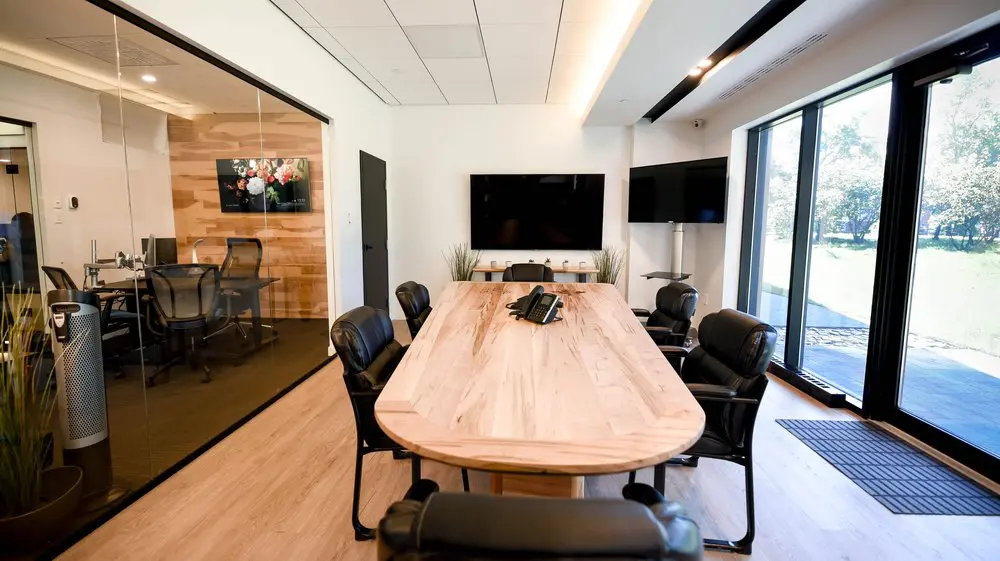
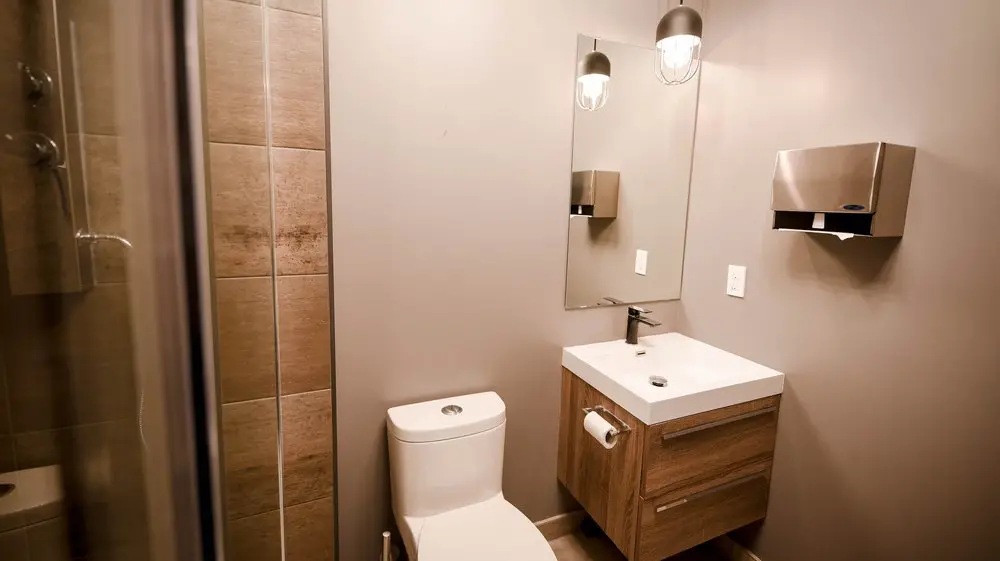
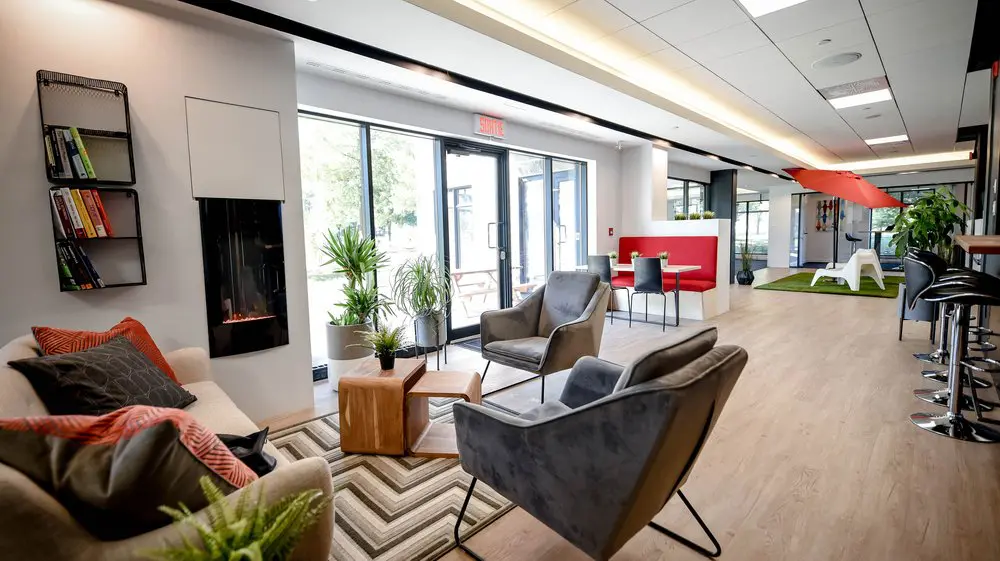
2727 Coworking space, 2727 Saint-Patrick, Montreal
Option 2: A Second Mobile Line or eSIM
What you get
A second mobile plan gives you a real wireless number with outgoing calls, texting and wireless 9-1-1, at prices close to a VoIP subscription. Modern phones can carry it on the same device. Apple explains that "Dual SIM enables you to have two active phone numbers or SIMs to make and receive calls and text messages", and suggests "Use one number for business and another number for personal calls"; it adds that "To use two carriers, your carrier must unlock your iPhone, or both plans must be from the same carrier" [44]. Google says that on a "Pixel 3a or later Pixel phone, you can use two SIMs: one physical SIM card and one eSIM", and two eSIM profiles on a Pixel 7 or later [45].
Entry prices in Quebec as of November 2026:
Fizz (Vidéotron's digital brand): "Phone plans start at $20/month", "there is no activation fee", "Free eSIM", and "Applicable taxes are extra (including 911 emergency service tax and/or levy of $0.54 in Quebec" [39]. The $0.54 figure on Fizz's page matches the 2025 rate; Revenu Québec's table shows $0.55 for 2026 [16].
Public Mobile (TELUS): "Canada-wide $22 / mo. 1GB" with "Unlimited Talk & Text", "$24 / mo. 5GB" and "Subscribe in minutes with eSIM" [40]. Its service terms anticipate business users ("If you are a business customer, any claim ... must be referred to private and confidential arbitration") and prohibit reselling the service [41].
Lucky Mobile (Bell): prepaid plans from "500 MB ... $22/mo." and "5GB ... $25/mo.", "Unlimited Canada-wide calls", voicemail, "Activate eSIM in minutes for free", with "One-time $10 SIM Card charge may apply" and "Taxes extra" [42].
Vidéotron Business mobile: one business plan reads "bringing the Mobile service rate to $40/month. The regular monthly service rate for the plan is $45", with the lower rate tied to an eligible Business Internet plan [43].
Plan cards on several carrier sites load through calculators that did not render for us, so check the current plan contents yourself. The point is the order of magnitude: about $20 to $25 a month before taxes for a talk-and-text line with eSIM.
What you give up
Shared answering. A mobile number rings one phone. Colleagues cannot pick it up without forwarding rules.
Business features. No auto-attendant ("press 1 for sales"), no queues, limited voicemail-to-email.
A clean exit for staff. If an employee carries the business eSIM, the number travels with the phone unless the account is clearly the company's.
Consumer protections that still apply
The CRTC's Wireless Code is not only for consumers. The Commission for Complaints for Telecom-television Services (CCTS) explains that "the goal of the Wireless Code is to make it easier for individual and small business customers to get information about their contracts for wireless services" [30]. For an indeterminate (month-to-month) contract with no subsidized device, "A service provider must not charge an early cancellation fee" [31]. For a fixed-term contract without a subsidized device, the fee "must not exceed the lesser of $50 or 10% of the minimum monthly charge for the remaining months of the contract, up to a maximum of 24 months" [31]. Landline and VoIP business contracts have no equivalent code, which is one reason their term matters more.
Who should choose it
A solo operator who calls and texts clients constantly from one phone, wants business caller ID on outgoing calls, and does not need colleagues to share the line.
Option 3: VoIP and UCaaS Business Phone Systems
What you get
A hosted VoIP or unified-communications (UCaaS) system puts your number in the cloud. You answer and call from a desk phone, a laptop or a mobile app; you can add an auto-attendant, ring groups, call recording, business texting and integrations. This is the right family for any business where more than one person handles calls, or where the business number must appear on outgoing calls from several devices.
The CRTC treats a provider that hands out North American numbers, connects to the public telephone network and carries local calls as a "local VoIP service provider", and lists three duties: provide 9-1-1, notify customers of its limitations, and register with the Commission [7]. That definition is why the 9-1-1 warnings appear in every sign-up flow below.
Provider by provider (as of November 2026)
RingCentral (RingEX). RingCentral's Canadian pricing page offers "Save up to 25% by paying annually", with the Core plan at "$30 ... /user/month* paid annually" against $40 when paid monthly, Advanced at $35 ($45 monthly) and Ultra at $45 ($55 monthly) [46]. Texting allowances are "25 SMS user/month", "100 SMS user/month" and "200 SMS user/month" by tier, calling is "Unlimited domestic calling", "Phone rental available only with multi-year contract", and an "E911 Service Fee ... 911 Fee ... may apply" [46]. Its emergency policy warns that its 911 service "will not function (i) in the event of an Internet or power outage" and, in capitals, that "VIRTUAL EXTENSIONS AND MOBILE USERS WITHOUT A DIGITAL LINE CANNOT COMPLETE 911 CALLS" [47]. The French version of RingCentral's pricing page labels the same lead prices as monthly billing; we rely on the English page's "paid annually" wording and suggest you confirm the billing basis at checkout.
Ooma Office (Canada). Ooma's Canadian site lists Essentials at "$24.95 Per User ... Per Month No Contract Necessary", Pro at $29.95 with "Text Messaging (up to 100/month)", Pro Plus at $34.95 with "Text Messaging (up to 400/month)", and "One FREE Toll-Free Number" [48]. The plans page shows prices in "CDN$", a "One-time activation fee" of $29.95, "No hardware required", and "*Applicable taxes and fees are not included" [51]. The rates page lists "Porting/Change Fee | Free" and "Phone Number | $9.99 per number" [49], while the porting page states "Porting a number is complimentary for all U.S. and Canada numbers", quotes "$14.95/month for Canadian accounts" for an additional number, and warns that "It may take 3-4 weeks to successfully port your number" [50]. The two pages disagree on the price of an extra number; get it confirmed. Ooma says emergency calls may be routed to "a national call center" and that the "911 service address is set during account creation" [52].
Dialpad. Dialpad's pricing page shows "Standard $15user/month" and "Pro $25user/month", "Unlimited domestic (US & CAN) minutes" on its sales plan, and the caveat that "The price you see on the website may differ from your actual price due to regional pricing and currency" [53]. The prices we could read were in US dollars; the page has a monthly or annual toggle but does not say which basis the figures use, so confirm the billing basis and any Canadian-dollar price with Dialpad before you buy. Its emergency article says "E911 dialling for emergency services via Dialpad is available for all plans", that the address "must be a physical location; PO boxes are not accepted", and that Dialpad will verify addresses added or edited in Canada [54].
TELUS Business Connect. TELUS markets its cloud system per seat "when bundled on a 3-year contract", includes "Texting within Canada", and offers to "Save $5 per month, on each Business Connect seat, when you bundle with other TELUS Business services" [55]. The per-seat prices are rendered by a calculator that did not display for us in either language, so ask TELUS for a written quote. Its FAQ confirms "Canadian SMS (on supported editions)", "No, we only provide Canadian phone numbers", and "Yes, you can port your existing business phone numbers to Business Connect" [56]. TELUS's VoIP 9-1-1 notice warns that "In the event of power, network, or Internet outages ... you may experience a failure, disruption or delay in your 9-1-1 service" [57].
Zoom Phone. Zoom's pricing page, loaded from Canada, lists "US & CA Metered CA$14.18 /user/month" and "US & CA Unlimited CA$21.60 /user/month", "billed annually", with "Domestic SMS ... Available in United States & Canada" and the note "Additional registration needed" [62]. The same page loaded from a US location showed US-dollar prices, so make sure you are looking at the Canadian version.
Microsoft Teams Phone. Microsoft Canada lists "Microsoft Teams Phone Standard CAD $13.60 user/month, paid yearly" on an annual subscription that auto-renews, "Teams Phone with pay-as-you-go calling (country zone 1) CAD $16.30" and "Teams Phone with domestic calling (country zone 1 - UK/Canada) CAD $23.10" [63]. Microsoft's French Canadian page describes the domestic plan as including a phone number provided by Microsoft with 3,000 minutes of local outgoing calls [84]. Microsoft's add-on page warns that "Annual commitment subscriptions paid month to month may incur some penalties if canceled early" [64]. It makes most sense for businesses already running on Microsoft 365.
Google Voice. This is where most Canadians get confused. The free, personal Google Voice is not available here: Google says those versions "don't require a paid Workspace subscription and are only available in the US" [65]. Google's standalone Voice Starter and Standard plans also show "Phone number in local country/region | US only" [66]. What does work in Canada is Google Voice as an add-on to Google Workspace: Google's supported-countries table lists "Canada | ✔ | ✔ | ✔ | Voice Starter, Standard, or Premier" [67]. The product page prices it at "Starter $10 USD per user / month", "Standard $20 USD" and "Premier $30 USD", "Available in 14 countries" [68]. Budget the Workspace subscription on top, in US dollars.
Vonage Business. Vonage's Canadian URL served UK plans in pounds when we checked, so we could not cite a Canadian-dollar price [60]. Its US page advertises "SMS and MMS" on mobile and a "12-MONTH PROMOTION" around $13.99 to $19.99 per line in US dollars [60]. What Vonage does publish for Canada is its fee schedule: a "Vonage 911 Fee ... This applies to all provinces at $0.99 per line" and a "Regulatory, Compliance, and Intellectual Property (RCIP) Fee ... Applies to all provinces at $3.50 per line" [61]. Those fees add $53.88 per line per year before taxes, which matters when comparing headline prices.
Fongo Works. Fongo, a Canadian provider, offers a business app with a free tier: "Stay free or upgrade for just $10/month", "Choose a local phone number during sign up. Transfer-in your existing number later", "Add up to 6 team members/extensions", and "Stay free forever" with "no trial limit" [58]. Free accounts "can become dormant and be deleted if left unused" [58]. The decisive fact for a Montreal user is on Fongo's 9-1-1 page: "911 Emergency calling service is unavailable for use with Fongo Mobile, Fongo Works and FreePhoneLine Desktop services in the provinces of Quebec, New Brunswick, Newfoundland and Labrador, and Prince Edward Island" [59].
voip.ms (do-it-yourself). For technically inclined users, Montreal-based voip.ms sells numbers and minutes à la carte: "Local Voice Numbers Monthly Fee ... Starting at $ 1.10 / DID", local calls "Starting at $ 0.005 / min", "Enhanced 911 $ 1.50 / DID", and "we won't lock you into a long-term contract" [69]. Its wiki states that charges are "processed in US dollars (USD)", texting costs "$0.0075/SMS", and accounts need a "minimum $15 account deposit" [70]. Its emergency page lists Canadian E911 at $1.50 and warns that "a $75 fee applies per 911 call attempts if E911 is not active on your number" [71]. You supply and configure the phone or softphone app yourself.
What you give up
Reliability is your internet's reliability. Every provider above repeats the CRTC's warning: no power or no internet means no calls, including 9-1-1, unless you have backup [6].
9-1-1 accuracy depends on you. The CRTC's model notice reads "When dialing 9-1-1, be prepared to provide your address/location", and warns that "the emergency operator may assume that you are calling from the last registered address" [7].
Any business with two or more people answering a shared number, any business that needs the business number on outgoing calls from computers and phones, and any sales or support operation that needs queues, recording or integrations.
2727 Coworking space, 2727 Saint-Patrick, Montreal
Option 4: Forwarding-Only and App-Based Numbers
What you get
At the light end, a number can exist purely to receive calls and send them to a phone you already own. Some app-based services go further and let you call out from the app.
Quo (formerly OpenPhone). Quo offers Canadian numbers "with your preferred area codes", listing for "Quebec, includes Montreal" codes such as 263, 438 and 514 [74]. Its pricing page lists Starter at $19, Business at $33 and Scale at $47 per user per month, or $15, $23 and $35 on yearly billing, with "One new or ported phone number (local or toll-free) per user" [72]. The page does not name a currency; Quo is a US company, so assume US dollars until the checkout says otherwise. Its help centre adds that "Additional phone numbers cost $5 per month regardless of your plan", "Porting numbers: Free (though third-party fees may apply)", and "All pricing excludes applicable taxes and fees" [73]. The pricing page also lists a one-time carrier registration fee for business texting ("$19.50 one-time" plus "$1.50 - $3/month"), a requirement that comes from US messaging rules; ask whether it applies to your Canadian setup [72].
Grasshopper. Grasshopper advertises "Quebec Phone Numbers / Local numbers throughout Canada" [75]. Its pricing cards did not render for us and its site gave contradictory messages about regional availability, so confirm pricing and availability directly.
Twilio (build your own). Developers can rent a Canadian local number from Twilio at "$1.15" per month, with inbound local calls at $0.0085 per minute and outbound at $0.0140, "Pricing current as of October 2026"; the page does not name a currency, and Twilio is a US company, so confirm the currency at checkout [76]. This is a raw building block: someone has to write the call flow, voicemail and forwarding logic.
Home VoIP lines. Fongo Home sells a Canadian number at "$4.95 / month *paid annually. $5.95/mo when paid monthly", with an adapter, "unlimited calls to any Canadian or United States phone number", and "Transfer Existing Number $5.95 at signup or $25 after signup" [77]. Freephoneline sells a "VoIP Unlock Key ... $69.95 + $1.95/Month" and a $25 one-time fee to keep an existing number [78]. These are residential products; read the terms before using them as a business line, and check the 9-1-1 limitations for Quebec on the provider's own page.
TextNow. Once popular with newcomers, TextNow announced that "After July 30, TextNow Wireless cellular coverage will no longer be available outside of the United States, impacting those currently using a TextNow SIM in Canada" [79]. Do not build a business line on a service that is shrinking its Canadian footprint.
Carrier forwarding. If you already have a business line with a carrier, forwarding is often included: both Bell's Fully-featured Business Line [34] and Vidéotron's Ligne Optimale [36] list it among included features.
What you give up
Your caller ID on callbacks. With a pure forwarding number, you return calls from your own cell, which shows your personal number. Clients save that number, and the separation you paid for erodes.
9-1-1 on the business number. A number that cannot dial out cannot dial 9-1-1. That is fine if everyone involved has another phone, and it must be stated in your own procedures.
Your carrier's minutes. A forwarded call uses minutes on the phone it rings. Long-distance or roaming charges on that phone are yours.
Who should choose it
A solo founder or consultant who needs a public local number for a website, a Google Business Profile or business cards, and is happy to call clients back from a personal phone or by email.
Option 5: A Number Bundled With a Mailbox or Virtual Address
What you get
Many virtual office and mailbox providers now bundle a phone feature. The labels vary widely, and the phone part can mean anything from voicemail to live answering. Three Montreal examples, as of November 2026:
Regus (IWG). Its Montreal page shows "Call answering Prices from$ 5 Per day" and "Virtual office plans Prices from$ 3 Per day" [80]. Its call-answering page says the service "includes a local number" and that call answering is "included in our standard virtual office plan, but not within our business address service" [81]. Per-day prices are hard to compare; ask for a monthly total including taxes.
Montréal Cowork. Its virtual office page lists a "Base 300$/an +txs" plan with a "Numéro de téléphone local", a "Bronze 35$/mois +txs" plan and an "Argent 75$/mois +txs" plan with a "Numéro local dédié" [82]. What the number does (forwarding, voicemail or answering) is not stated on that page.
2727 Coworking. Every mailbox plan includes a local number that forwards to your cell, covered in its own section below.
What to check
The questions are the same as for any forwarding number, plus two that are specific to bundles: does the number survive if you downgrade or cancel the address, and can you port it out? A bundled number is only as permanent as the subscription it rides on. Live answering, receptionists and the difference between answering services and forwarding are a separate topic with their own trade-offs; this guide does not compare them.
2727 Coworking space, 2727 Saint-Patrick, Montreal
The Price Comparison Table (as of November 2026)
All prices are as published on the provider's page on November 15, 2026, before GST, QST, the municipal 9-1-1 tax and provider fees unless stated. "USD" means the page showed US dollars. A blank or "ask" means the page did not show the figure. Promotional prices are marked.
Option
Plan
Published price
Billing basis and term
Outgoing calls
Texting
9-1-1
Source
Bell business line
Fully-featured Business Line
$35.43/mo (from $25.43 with Internet) + $125 install
Promotional, 3-year term, up to $10/mo annual increase, auto-renews
Three things stand out. First, the cheapest options are cheap because something is missing: Fongo Works has no 9-1-1 in Quebec, voip.ms makes you the integrator, and forwarding numbers cannot call out. Second, the UCaaS prices cluster between about $14 and $35 per user per month once you strip promotions, but the billing basis (annual vs monthly) can move the price by 25% or more. Third, carrier landlines look moderate per month but carry installation fees and multi-year terms.
Worked Cost Examples
The examples below use published prices and the 2026 tax rates. They assume the business is in Montreal, uses a Quebec number and pays GST and QST. They are illustrations, not quotes. Where the municipal 9-1-1 tax applies, we add $0.55 per number per month and apply GST and QST on top, because Revenu Québec's French-language page instructs providers to calculate GST and QST "sur le prix comprenant la taxe municipale pour le 9-1-1", that is, on the price including the 9-1-1 tax [85]. The combined GST and QST factor is 1.14975 [19].
Example A: a solo consultant who needs a public number
Profile: works from home and a coworking day pass, gets a few client calls a week, answers email for everything else, wants a number on the website and on invoices that is not a personal cell.
Route
Monthly, before taxes
Monthly, all taxes in
Year one, all taxes in
What is missing
Fongo Works free tier
$0
$0
$0
9-1-1 in Quebec; free accounts may be deleted if dormant
Fizz second line, $20 plan, eSIM
$20.00 + $0.55 9-1-1 tax
$23.63
$283.53
Shared answering and auto-attendant
Mailbox plan with an included forwarding number (2727, $35 Mailbox plan)
$35.00
$40.24
$482.89 monthly, or $402.41 with annual prepay
Outgoing calls and 9-1-1 on that number; but includes a civic business address
RingCentral Core, one user, annual billing
$30.00
$34.49 + any 911 fee
$413.91 + fees
Nothing major; more than this profile needs
The calculation for Fizz is (20.00 + 0.55) × 1.14975 = $23.63 per month. For the mailbox bundle, the comparison only makes sense if you also need the address; if you do, the phone line is effectively included in a cost you were going to pay anyway. If you do not need an address, a second mobile line or a free app is cheaper.
Example B: a three-person team sharing a main line
Profile: an agency of three, one main number with an auto-attendant, everyone calls out with the business caller ID, some texting.
Route
Before taxes, per month
Year one, GST and QST in (no fees)
Notes
RingCentral Core, annual billing
3 × $30 = $90.00
$1,241.73
Monthly billing would be 3 × $40 = $120.00, or $1,655.64 a year
Ooma Office Essentials
3 × $24.95 = $74.85, plus one $29.95 activation
$1,067.14
Texting starts on Pro at $29.95 per user
Zoom Phone US & CA Unlimited
3 × CA$21.60 = $64.80
$894.05
Billed annually
Microsoft Teams Phone with domestic calling
3 × $23.10 = $69.30
$956.13
Assumes the team already pays for eligible Microsoft 365 licences
Vonage
Ask for a CAD quote
Add $53.88 per line per year in Canadian fees
3 lines = $161.64 before taxes in fees alone
For each number that can dial 9-1-1 with a Quebec area code, add the municipal 9-1-1 tax: three numbers × $0.55 × 12 = $19.80 a year before GST and QST [18]. We assumed one Ooma activation fee per account; confirm whether it is charged per user.
Example C: a storefront that needs a fixed line
Profile: a small studio with walk-in clients and staff on site, expected to stay at the address for at least three years.
Bell's Fully-featured Business Line without Internet: $35.43 × 12 + $125 installation + $0.55 × 12 municipal tax = $556.76 before GST and QST, or $640.13 with them, for year one. Over three years, before any annual increase: $35.43 × 36 + $125 + $0.55 × 36 = $1,420.28, or $1,632.97 with GST and QST [33]. The promotional terms allow an increase of up to $10 per month per service each year, so the realistic three-year figure is higher. The Vidéotron Ligne Optimale Solo on a 60-month agreement at $35.90 comes to $502.90 a year with the 9-1-1 tax and GST and QST, before installation; the 12-month option at $48.90 comes to $682.26 a year [36].
Example D: a newcomer setting up before arriving
Profile: a founder relocating to Montreal who wants a local number for a website and registration paperwork before having a Canadian address or credit history.
The practical choices are an app-based number (Quo, Fongo Works) or a bundled number with a mailbox. Two cautions apply. First, a forwarding number generally needs a forwarding destination; 2727's terms, for example, require "a valid forwarding number in Canada or the United States" that the client controls; a Canadian or US number from a VoIP calling app on a phone used abroad qualifies, subject to the app provider's own charges and availability. Second, any VoIP service used from outside Canada is nomadic by definition, so 9-1-1 location data cannot be trusted. The detailed situation of non-residents gets its own treatment elsewhere; here, the cost logic is the same as Example A.
2727 Coworking space, 2727 Saint-Patrick, Montreal
What You Get and What You Give Up: Feature by Feature
Feature
Carrier landline
Second mobile / eSIM
UCaaS
Forwarding-only
Mailbox bundle (2727)
Local 514/438/263 number
Yes
Yes
Yes
Yes
Yes, 438, 514 or 263 depending on availability
Outgoing calls with business caller ID
Yes
Yes
Yes
Usually no
No
Texting
No
Yes
Often, with caps
Sometimes inbound
Inbound, delivered by email
Auto-attendant ("press 1")
Limited
No
Yes
Sometimes
Yes: 1 Sales, 2 Administration by default; up to 7 options, greeting and business hours set by you in the portal
Voicemail to email
Sometimes
Rarely
Yes
Usually
Yes, with transcript
Several people answer
Hunt groups
No
Yes
Depends
No (rings one forwarding number)
9-1-1
Traditional
Wireless
Enhanced at a registered address, with outage limits
Usually none
None
Works in a power or internet outage
Depends on the line technology
Yes, if the cell network is up
No, without backup
Depends on the destination phone
Depends on your cell
Porting out
Yes, local portability
Yes
Usually
Varies
Reasonable efforts on written request
Typical commitment
1 to 5 years
None to 2 years
Monthly to 3 years
Monthly
Monthly or annual prepay
9-1-1: The Rules and Their Limits
The CRTC's distinction between fixed and nomadic VoIP
The CRTC's consumer page draws the line clearly. "With Fixed VoIP service, calls can only be made from a fixed address." By contrast, "Nomadic VoIP service provides Basic 9-1-1 service because there is no fixed address to provide to 9-1-1 operators." It asks users to "Make sure your location information is up to date with your service provider", and warns that "During a power (unless battery back-up is provided) or an Internet outage, VoIP services, including 9-1-1, will be unavailable" [6].
Those obligations go back to 2005. In Telecom Decision CRTC 2005-21, the Commission directed carriers offering fixed local VoIP services to provide 9-1-1 or Enhanced 9-1-1 service "within 90 days" (paragraph 52), and required for nomadic services "an interim solution ... that is functionally comparable to Basic 9-1-1 service" (paragraph 68) [8]. The same decision called for "warning stickers affixed to telephone sets and billing inserts" (paragraph 94) and required providers to "obtain, prior to commencement of service, the customer's express consent" (paragraph 98) [8]. That is why a VoIP sign-up asks you to click "I agree" to a 9-1-1 notice.
Notification is a continuing duty
Telecom Decision CRTC 2005-61 required notification to existing customers "within 90 days ... and annually on an on-going basis" (paragraph 4), notices in terms and contracts that "must use 12 point font, at a minimum" (paragraph 12), and new providers to submit their notices "for review by the Commission, prior to offering service" (paragraph 16) [9]. The CRTC's current page for providers repeats that notifications "must be provided to customers upon sign-up and installation, in marketing materials, and in the terms of service" [7].
Next-Generation 9-1-1 is still in transition
In 2017 the CRTC set out the move to Next-Generation 9-1-1 (NG9-1-1), originally requiring networks to be "ready to provide NG9-1-1 Voice service by 30 June 2020" and to decommission legacy components "by 30 June 2023" [10]. Those dates were pushed back. In Telecom Decision CRTC 2025-67, the Commission set "a revised deadline of 31 March 2027 for the transition to NG9-1-1", after which "only NG9-1-1 calls will be delivered" [11]. The CRTC's NG9-1-1 page confirms that "A deadline for providing NG9-1-1 real-time text messaging to the general public will be set at a later date" [12]. For a small business, the takeaway is simple: do not assume texting 9-1-1 is available, and expect providers to update their 9-1-1 terms through 2027.
What this means in practice
Situation
What to do
You use a VoIP app on a laptop in different places
Treat its 9-1-1 as Basic at best; keep a mobile phone for emergencies
You have a fixed VoIP desk phone at your premises
Register the exact civic address and unit; update it the day you move
Your provider says 9-1-1 is unavailable in Quebec
Everyone on site needs another phone that can dial 9-1-1
You use a forwarding-only number
The business number cannot dial 9-1-1; write that into your safety procedures
Staff work at the premises
Make sure at least one line or mobile phone at the premises can reach 9-1-1 during a power or internet outage
2727 Coworking space, 2727 Saint-Patrick, Montreal
Keeping Your Number: Portability
The rule and its exceptions
Local number portability has been part of Canadian local competition since Telecom Decision CRTC 97-8, which stated that "all LECs will be required to implement local number portability as approved by the Commission" (paragraph 282) [14]. Wireless number portability followed in Quebec and other provinces "by 14 March 2007", and the CRTC set "the appropriate service interval for wireless-to-wireless simple porting" at "2.5 business hours" (paragraph 92) [15].
The CRTC's consumer page gives the key practical rule: "Most importantly, do not cancel your service before you switch to the new provider." It adds that "For mobile phones, it can take a few hours. For landline to mobile or mobile to landline, it typically takes up to 2 business days", and lists cases where "You might need to get a new phone number", including "Voice over IP (VoIP) to landline" and "Landline to VoIP" [13]. In other words, portability is the norm, not a guarantee, and moves between technologies are where it most often fails.
Provider timelines vary. Ooma warns that "It may take 3-4 weeks to successfully port your number" [50], and TELUS confirms you can port existing business numbers into Business Connect [56]. Fees vary too: free at Ooma and Quo, $5.95 at signup or $25 afterward at Fongo Home, and a $25 one-time fee at Freephoneline [49][73][77][78].
How to port a number without losing calls
Before you sign: ask the new provider whether it can port your number from your current provider and technology (mobile, landline, VoIP). Get the answer in writing.
Collect your account details: account number, the exact name and service address on the account, and any porting PIN your current provider requires.
Keep the old service active. Do not cancel it. The port itself closes the old account for that number.
Submit the port with the new provider and set up the new service (greeting, forwarding, voicemail) on a temporary number while you wait.
Test on port day: call from a mobile on another network and from a landline; send a text; leave a voicemail.
Then close anything left on the old account (other lines, equipment rental) and check the final bill.
Bundled and reseller numbers
With a bundled or reseller number, your portability depends on the contract. Read the number clause before you print the number on signage. 2727's phone-line terms, for example, say the number "remains assigned to 2727 Coworking with its suppliers and the Client acquires no right in it", and that on "a written request received before the subscription ends", 2727 "will make reasonable efforts to allow the number to be ported to another provider, subject to applicable rules and technical feasibility" (phone line terms). That is a common and fair formulation, and it means you should ask before you cancel, not after.
Other Rules Worth Knowing
Small-business complaints go to the CCTS
The CCTS handles complaints from small businesses as well as individuals, provided "a monthly bill for all telecommunications services is normally under $2,500" [32]. It is a free route when a provider will not fix a billing or porting problem.
Outbound calling and the National Do Not Call List
If your number will be used for sales calls, the telemarketing rules apply to you, not only to call centres. The National Do Not Call List operator states that registration is required for "Telemarketers who make telemarketing calls on their own behalf, regardless of whether or not such calls fall under the National DNCL exemptions" [28]. The CRTC's obligations page for telemarketers begins with "Telemarketers must register with the National Do Not Call List" [29]. A forwarding number does not raise this issue; an outbound sales line does.
French-language and greeting rules
Quebec's language rules affect business greetings, menus and messages. That is a separate subject; if you serve Quebec customers, plan a French greeting and have it reviewed against current requirements.
2727 Coworking space, 2727 Saint-Patrick, Montreal
Taxes on Telephone Services in Quebec
GST and QST
Telephone services bought by a Montreal business are taxable at the GST rate of 5% and the QST rate of 9.975% [19]. Telecommunications have their own place-of-supply rules: under GST/HST Memorandum 3-3-6-1, a telecommunication service is supplied in a province when "the telecommunication is both emitted and received in that province", or when it is "emitted or received in that province and the billing location for the service is located in that province" (paragraph 66) [20]. Foreign providers billing a Quebec business may or may not charge Canadian taxes depending on their registration status; that is a question for your accountant when you book the invoice.
The municipal 9-1-1 tax
Quebec adds a fixed monthly municipal tax for 9-1-1 service. Revenu Québec explains that "the tax is a set monthly amount for each telephone service and is charged per telephone number (or per outgoing access line for a multiline service other than a Centrex service)", with a rate table showing $0.55 from January 1 to December 31, 2026, and $0.57 for 2027 [16]. "Telephone service providers collect the municipal tax for 9-1-1 service and remit it to us" [17].
The regulation defines a "telephone service" as one where "9-1-1 can be dialled to reach directly or indirectly a 9-1-1 emergency centre providing services in Québec", deemed provided in Quebec "where the telephone number assigned to the client for using the service has a Québec area code", at "$0.55 a month per telephone number" [18]. The definition is technology-neutral, so mobile and VoIP numbers that can reach 9-1-1 are covered. Read your bill: Bell states that "The municipal service taxes (55¢/mo.) are not included" in its business line price [33], while Lucky Mobile says such fees "are included in your monthly plan charge" [42].
Input tax credits and refunds
If your business is registered for GST and QST, "you can generally recover the GST/HST and QST you paid (or have to pay) on taxable property and services by claiming input tax credits (ITCs) and input tax refunds (ITRs)" [21]. The CRA lists "telephone and utilities" among expenses for which you "may be eligible to claim ITCs" [22]. Two limits apply. Revenu Québec states that "municipal taxes" do not give entitlement to ITCs or ITRs because they are not subject to GST or QST, so the 9-1-1 tax itself is not recoverable, and that "you cannot claim ITCs or ITRs on property and services acquired for personal use" [21]. A shared personal and business phone needs an allocation; ask your accountant how to document it.
Is a Business Phone Deductible?
Self-employed individuals (federal)
The CRA's guidance on line 9220 is precise: "Do not deduct the basic monthly rate of your home telephone." However, "If you have a separate telephone for business calls only, you can deduct its basic monthly rate", and "You can also deduct the percentage of airtime expenses for a cellphone you use to earn your business income" [23]. The T4002 guide adds that "If you buy a computer, cellular telephone, fax machine, or other such equipment, you cannot deduct the cost"; equipment goes through capital cost allowance instead [24]. The general principle is that "since you cannot deduct personal expenses, enter only the business part of expenses on Form T2125, T2042 or T2121" [25].
Self-employed individuals (Quebec)
Revenu Québec's guide to business and professional income takes the same line: "You can deduct the following expenses only if they were incurred exclusively for business purposes: • the basic monthly charge for telephone service" [27]. Cellular charges are deductible in proportion to business use, and the purchase price of the phone is not deductible as a current expense.
Employees
Employees claim under different rules. In the CRA's table of home-office expenses employees can claim, a basic cell plan is claimable "if all conditions are met", including being "able to show the cellular minutes or data you consumed directly while performing your employment duties", while the "Monthly basic home phone (land-line) rate" is marked "No" [26]. Employees must also meet the employer-certification conditions the CRA describes on that page and its related forms.
Why a separate number simplifies the paperwork
Setup
Deduction logic
Record-keeping burden
Personal cell used for business
Business percentage of airtime only
Keep logs or a reasoned allocation
Dedicated business mobile line
Full basic rate if used only for business
Low: one bill, one purpose
VoIP or UCaaS subscription for the business
Business expense if used for the business
Low
Mailbox plan that includes a number
Business expense if the plan serves the business
Low
Home landline also used for business
Basic rate not deductible; business long distance may be
Medium
For incorporated businesses, contracts in the corporation's name and paid by the corporation are generally treated as corporate expenses, but how to handle a phone used by a shareholder personally is exactly the kind of question to settle with your accountant.
2727 Coworking space, 2727 Saint-Patrick, Montreal
A Decision Framework by Business Type
Start with four questions
Will you call clients from this number? If yes, rule out forwarding-only numbers and bundles that are incoming only.
Will more than one person answer it? If yes, you need a UCaaS system (or a carrier hunt group).
Is anyone physically at a fixed premises where 9-1-1 matters? If yes, make sure a carrier line, a mobile phone or a fixed VoIP line with a registered address is there.
Do you also need a business address? If yes, compare the bundled number against the cost of the address you were going to pay for anyway.
The framework
Business profile
Usually the best fit
Why
Watch out for
Solo consultant, mostly email, needs a public number
Forwarding number, or a mailbox plan that includes one
Cheapest way to keep a personal cell off the website
Callbacks from your cell show your personal number
Freelancer who calls and texts clients daily
Second mobile line or eSIM
Real caller ID, texting and wireless 9-1-1 on one device
9-1-1 tied to the address, works with the building
3- to 5-year terms, installation fees, auto-renewal
Technically skilled owner on a tight budget
DIY VoIP (voip.ms) or a free app
Very low monthly cost
You are the support desk; check 9-1-1 coverage in Quebec
Newcomer not yet in Canada
App-based number or bundle
Works before you have a Canadian address or credit
Nomadic 9-1-1; forwarding destinations limited to certain countries
Combinations are normal
Many small businesses run two layers: a public number on a cheap forwarding or bundled service, and a mobile line or UCaaS seat for outgoing calls. That is fine as long as you decide which number clients should save. If clients will call you back on whatever number appeared on their screen, the number you call out from becomes your real business number, whatever is printed on your website.
Setting Up a Business Number, Step by Step
Write down the job. Inbound only or outbound too? Texting? How many people? Which hours? Which languages?
Pick the family using the framework above, then shortlist two providers.
Read three pages per provider before paying: the pricing page (billing basis, term, fees), the 9-1-1 page (coverage in Quebec, how to register an address), and the porting or number clause (can you leave with the number).
Choose the number. A 514, 438 or 263 number is equally local. Avoid vanity hunting that delays launch; a memorable number matters less than a consistent one.
Record the greeting and decide what callers hear outside business hours. Keep it short and bilingual if you serve Quebec customers.
Set up voicemail delivery to an address that someone actually reads, and decide who calls back and how fast.
Register the 9-1-1 address if the service supports it, and tell your team which phone to use in an emergency if it does not.
Publish the number consistently: website, invoices, email signature, Google Business Profile and directories. Keep name, address and phone identical everywhere; our guide to Google Business Profile and virtual addresses explains why platforms compare them.
Test from outside: call from another carrier, text the number, leave a voicemail, and check what appears on your caller ID when you call back.
Diary the contract dates: end of promotional pricing, renewal date, annual increase dates.
2727 Coworking space, 2727 Saint-Patrick, Montreal
Common Failure Modes
Failure
What happens
How to avoid it
Cancelling before porting
The number is released and may be impossible to recover
Port first; let the port close the old service [13]
Relying on a VoIP app for 9-1-1 in Quebec
The call may fail or reach the wrong centre
Check the provider's Quebec 9-1-1 page; keep a mobile phone
Register with the National DNCL before calling [28]
How 2727 Coworking Fits
2727 Coworking is a coworking space at 2727 Rue Saint-Patrick in Griffintown, on the Lachine Canal. Every one of its virtual mailbox plans now includes a local Montreal phone number at no extra charge, from $35 per month before taxes (as of November 2026). The four plans are Mailbox ($35), Mailbox + Scanning ($85), Virtual Address ($135) and Virtual Office ($165) per month, before GST and QST, and annual prepay charges 10 months for 12. You can subscribe at booking.2727coworking.com/mailbox, and the phone feature has its own page at /virtual-phone-number/.
How the line works:
You pick your number in the client portal, from available 438, 514 or 263 numbers, depending on availability.
Callers hear a greeting in French and English, then a menu that is "1 Sales, 2 Administration" by default. In the portal you can write your own greeting in both languages, choose the first language, set business hours (one window on the days you pick, Montreal time; voicemail outside them) and build a menu of up to seven options, each ringing your cell, going to voicemail or playing a message you write. Changes are live when you save.
Calls ring your cell (a forwarding number in Canada or the United States that you control, which can also be a number from a VoIP calling app), so you see who is calling and answer as usual.
Missed calls go to voicemail, delivered by email with an automatic transcript; texts sent to the number also arrive by email.
Up to 300 minutes are forwarded per calendar month; past that, calls go to voicemail until the 1st.
What it is not: it is a forwarding line, not a phone system. It receives calls and texts only. It cannot place calls or send texts, and it cannot reach 9-1-1, so you need another phone for emergencies. When you call a client back from your cell, they see your cell number. The number stays assigned to 2727 with its suppliers; on a written request before your subscription ends, 2727 will make reasonable efforts to allow it to be ported. The full conditions are in the phone line terms.
Who should choose something else: anyone who needs to call out with the business number, send texts, have several people answer, or run sales calls should use a VoIP system or a second mobile line, possibly alongside a mailbox address. The 2727 number fits founders who want a local, bilingual front door that rings their cell, together with a civic business address, in one subscription.
2727 Coworking space, 2727 Saint-Patrick, Montreal
Frequently Asked Questions
What is a virtual business phone number?
It is a phone number that is not tied to one physical line. Calls to it are routed over the internet or the carrier's network to wherever you choose: an app, a desk phone or your existing cell. The number itself is an ordinary 10-digit Canadian number; "virtual" describes how it is delivered.
Can I get a 514 or 438 number without a landline?
Yes. Mobile plans, VoIP systems, app-based services and mailbox bundles all offer Montreal numbers. New numbers are more often 438 or 263 than 514, because overlay numbers are assigned on a first-come, first-served basis as older codes fill up [2]. All three codes are local to Montreal callers.
How much does a business phone number cost in Montreal?
As of November 2026, from $0 (a free app tier with major limits) to about $20 to $25 a month for a second mobile line, about $14 to $55 per user per month for VoIP systems, and about $25 to $49 a month for a carrier business line on contract, before taxes. See the comparison table above for sourced figures.
Is there a free business phone number in Canada?
Fongo Works offers a free tier with a local number [58], but its 9-1-1 calling is unavailable in Quebec [59], and free accounts can be deleted if dormant. Free is workable for a secondary number, not for your only business line.
Does Google Voice work in Canada?
The free personal Google Voice does not: Google says it is "only available in the US" [65]. Google Voice as a paid add-on to Google Workspace does support Canada for its Starter, Standard and Premier tiers [67].
Can I keep my number if I change providers?
Usually, yes. Local and wireless number portability are CRTC requirements, but the CRTC lists cases where you might need a new number, including moves between VoIP and landline [13]. Confirm with the new provider before you sign, and never cancel the old service first.
How long does it take to port a business number?
The CRTC says mobile ports can take a few hours and landline-to-mobile ports typically up to two business days [13]. VoIP providers can take longer: Ooma warns of three to four weeks [50].
Does a VoIP number work with 9-1-1?
It depends on the service. Fixed VoIP can provide Enhanced 9-1-1 to a registered address; nomadic VoIP provides Basic 9-1-1, where the operator may not know your location; and during a power or internet outage, VoIP 9-1-1 is unavailable [6]. Some services have no 9-1-1 in Quebec at all.
What is the 9-1-1 charge on my phone bill?
It is Quebec's municipal tax for 9-1-1 service: $0.55 per telephone number per month in 2026 and $0.57 in 2027, collected by your provider and remitted to Revenu Québec [16]. It applies to services that can dial 9-1-1 and use a Quebec area code [18].
Do I pay GST and QST on a business phone service?
Yes, at 5% and 9.975% [19]. If your business is registered, you can generally claim them back as input tax credits and refunds for the business portion, but not the municipal 9-1-1 tax [21].
Is a business phone tax deductible in Canada?
A phone used only for business is deductible, including its basic monthly rate; the basic monthly rate of a home phone is not, and a cell used for both is deductible in proportion to business use [23][27]. Ask your accountant how to document the split.
Can I deduct my personal cell phone?
Only the business share of airtime, if you are self-employed [23]. The phone itself is capital equipment, not a current expense [24]. Employees follow separate conditions [26].
Can I text from a virtual business number?
With a mobile line, yes. With VoIP systems, often, within plan caps: RingCentral includes 25 to 200 SMS per user per month depending on the plan [46], and Ooma's texting starts with its Pro plan [48]. Forwarding-only numbers may receive texts but usually cannot send them.
Can I make outgoing calls with a forwarding number?
Usually not. A forwarding number sends incoming calls to your phone; when you call back, the call goes out on that phone's own number. If outgoing caller ID matters, choose a mobile line or a VoIP system.
Will clients see my personal cell number when I call them back?
Yes, if you call from your personal cell. That is the main limit of forwarding-only numbers. VoIP apps let you call from the business number on the same phone.
Do I need a Quebec phone number to register a business in Quebec?
No. But a phone line in Quebec is one of the criteria the Government of Quebec uses to decide whether an enterprise carries on activities in Quebec, alongside a Quebec address and other factors [1]. A business based elsewhere that takes a Montreal number should check whether it must register.
Does a virtual office include a live receptionist?
Not necessarily. Some plans include call answering by staff, others only a forwarding number or voicemail. Regus, for example, says call answering is included in its standard virtual office plan but not in its business address service [81]. Read what the phone feature actually does.
Can I use a virtual number on my Google Business Profile?
You can publish any number you answer, but keep name, address and phone consistent across your website, the business registry and your listings, and expect Google to verify your business on its own terms. Our Google Business Profile guide covers the verification methods and the address rules.
Are business phone contracts long in Canada?
They range widely. Ooma advertises "No Contract Necessary" [48]; RingCentral discounts annual payment [46]; TELUS Business Connect prices assume a 3-year bundle [55]; Bell's promotional line uses a 3-year term that renews automatically [35]. For wireless, the Wireless Code caps cancellation fees for small business customers [31].
What happens to my number if I cancel?
On a direct carrier or VoIP account, you can usually port it out before cancelling. On a bundled or reseller number, it depends on the contract. With 2727, the line ends with the subscription, the number may be reassigned 30 days after the subscription ends, and a port request must be made in writing before the subscription ends (phone line terms).
Can I have two numbers on one smartphone?
Yes, with dual SIM or two eSIMs on recent iPhones and Pixels [44][45], or with a VoIP app alongside your mobile number. To use two carriers on an iPhone, the phone must be unlocked.
Do I need a toll-free number?
Rarely, for a small local business. A local number reads as local and is free for Montreal callers. If you need one, Ooma includes one free toll-free number [48], and Vidéotron Affaires charges $0.04 per minute for its toll-free numbers [36].
Can I complain about a phone provider as a small business?
Yes. The CCTS accepts complaints from small business customers whose monthly bill for all telecommunications services is normally under $2,500, free of charge [32].
Do I need to register with the National Do Not Call List?
If you make telemarketing calls, yes, including calls on your own behalf [28]. A number used only to receive calls does not trigger the obligation.
Does the 2727 mailbox number make outgoing calls or reach 9-1-1?
No. It is incoming only: it receives calls and texts, forwards calls to your cell and emails voicemails (with transcript) and texts. It cannot place calls, send texts or reach 9-1-1 (phone line terms).
How many minutes does the 2727 number include?
Up to 300 forwarded minutes per calendar month, with an email notice at 80%. Past the allowance, calls go to voicemail until the 1st of the next month, and unused minutes do not carry over (phone line terms).
Can I still have a fax number?
Some VoIP and carrier services sell fax features, and a few virtual office plans mention them. Most Canadian businesses and agencies now accept documents by email or upload, so check whether you truly need fax before paying for it, and ask the provider how faxes are delivered.
Is a Montreal number useful if I live outside Montreal?
It can be, for presence and for customers who prefer to call a local number. Keep in mind that a VoIP number used away from its registered address is nomadic for 9-1-1 purposes [6], and that registration rules in Quebec can be triggered by a local phone line [1].
Conclusion
A Montreal business number can cost nothing or several hundred dollars a year, and the difference is rarely about the number itself. It is about what surrounds it: outgoing calls with the right caller ID, texting, shared answering, 9-1-1 that reaches the right address, a clean exit through portability, and a contract you can live with. Pick the family first (carrier line, mobile line, VoIP system, forwarding number or address bundle), then compare providers within it on their all-in annual cost with GST, QST and the $0.55 municipal 9-1-1 tax included.
For most solo founders, the honest answer is a combination: a public local number that rings their cell, plus a mobile line they already pay for. For teams, a UCaaS system is worth its per-user price. For fixed premises with people on site, keep a line that reaches 9-1-1 at the address. Whatever you choose, read the number clause before you print the number, port before you cancel, and keep the account in the business's name. For deductions, input tax credits and corporate ownership of the contract, confirm the details with your accountant.
2727 Coworking space, 2727 Saint-Patrick, Montreal
References
[1] About the Registration of an Enterprise, Gouvernement du Québec
[2] Frequently Asked Questions, Canadian Numbering Administrator
[20] GST/HST Memorandum 3-3-6-1, Place of Supply in a Province, Personal Services, Services in Relation to Property and Telecommunication Services, Canada Revenue Agency
[21] Input Tax Credits and Input Tax Refunds, Revenu Québec