Answering the Phone in French and English in Quebec: What the Charter Requires and How to Write a Bilingual Greeting, Menu and Voicemail (2026)
What Quebec's French language Charter requires on business phone lines, plus ready-to-use French and English greeting, menu and voicemail scripts.
Executive Summary
If your business has clients in Quebec, your phone line is one of the places where the Charter of the French language applies most directly. The Charter gives consumers a fundamental right to be informed and served in French, and since the 2022 reform (Bill 96, enacted as the Act respecting French, the official and common language of Québec) it also places a direct duty on every enterprise that offers goods or services to respect that right. For a public other than consumers, such as other businesses, the enterprise must inform and serve it in French. [2][3]
The Charter does not ban English on the phone. Where the Act does not require French exclusively, French and another language may be used together. [4] What the Office québécois de la langue française (OQLF) expects is practical and measurable: French service must be available through every channel the business uses, including the telephone, at all times, under conditions equivalent to service in another language (waiting time, quality, precision), and the French information must be understandable on its own. [7]
In practice, that gives a simple design rule for a bilingual line:
Greeting and menu: French first, short English instruction, back to French. This is the structure the OQLF's Banque de dépannage linguistique (BDL) recommends for centralized phone services. [12]
Live answer: whoever picks up must be able to serve in French, or hand the call without extra delay to someone who can. The OQLF tells non-compliant businesses that there must always be one or more employees able to inform and serve the public in French. [10]
English on request: if a client asks for English, you may serve them in English. [13] Clients outside Quebec can be served in whatever language suits them; the Charter does not require French with an international clientele. [14]
Written follow-ups: emails, texts, quotes, invoices and standard-form contracts carry their own rules. Invoices and contracts of adhesion must exist in French, and the French version must not be harder to get than the other one. [17][18]
Enforcement usually starts with a complaint. The OQLF contacts the business, explains the breach and supports corrections. Fines ($700 to $7,000 for an individual, $3,000 to $30,000 in other cases, doubled and tripled for repeat offences) come into play when a business disobeys an OQLF order. They are imposed by the courts after a prosecution, not by the OQLF itself. [32][35]
The second half of this guide is practical. It gives greeting, menu and voicemail scripts for different kinds of businesses, in French first and then English, written with OQLF-recommended phrasing. It also covers anglicisms to avoid, phrases for staff who are still learning French, accessibility tips, and a checklist. Sources were accessed on November 15, 2026, and the law is described as of November 2026. This is general information, not legal advice. For a regulated sector, a franchise system, heavy outbound marketing or a complaint already filed, talk to a Quebec lawyer.
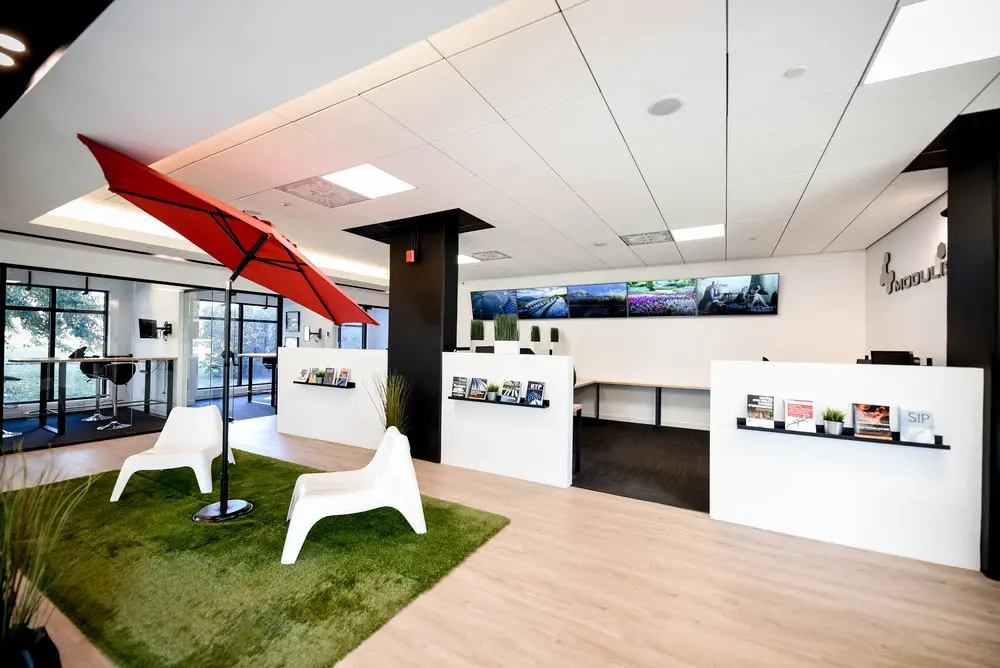
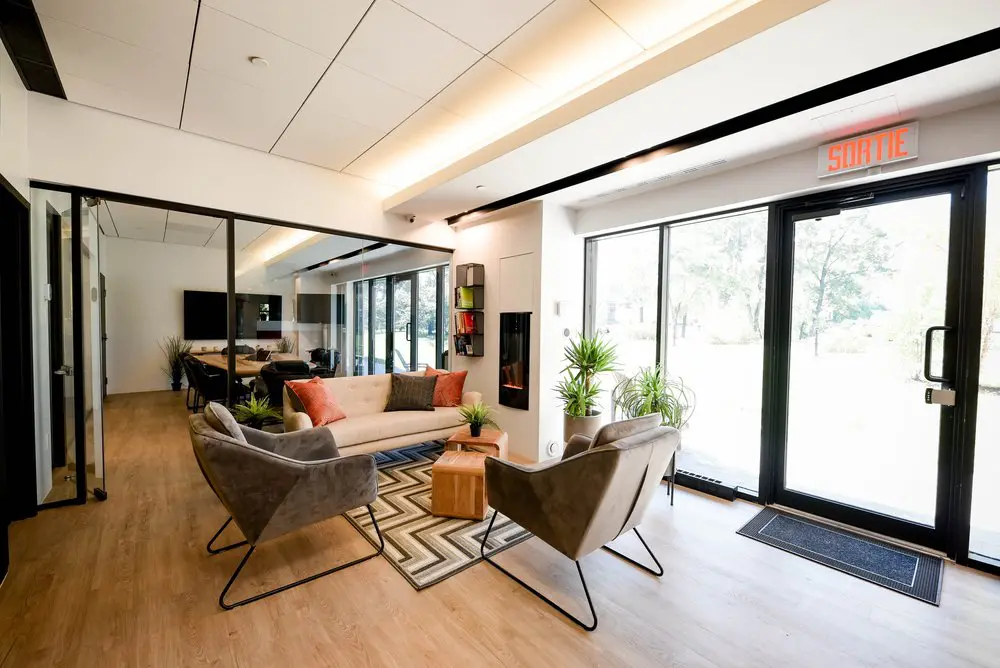
2727 Coworking space, 2727 Saint-Patrick, Montreal
What This Guide Covers, and What It Leaves Out
This guide answers two questions that founders and small teams with Quebec clients keep asking, often in the same breath:
What does Quebec law actually require when my business answers the phone, records a greeting, runs a phone menu or leaves a voicemail?
What exactly should the greeting say, in French and in English, and how do I avoid sounding like a word-for-word translation?
It does not compare phone providers, explain call forwarding versus answering services, or cover number portability. Those are separate decisions. It also does not cover the language of work inside your company (job postings, employment contracts, internal communications) except where those rules touch the people who answer your phones.
Throughout, the guide separates three kinds of statements:
Type of statement
How it is marked
Example
What the law says
Cited to LégisQuébec, the Gazette officielle or the Bill 96 text
"An enterprise that offers goods or services to consumers must respect their right to be informed and served in French."
How the OQLF applies it
Cited to OQLF pages, guides, letters and reports
French service must be offered "at all times" and under equivalent conditions
Good practice
Stated as a recommendation, often with a BDL or GDT source for wording
Start the greeting in French; say "poste" rather than "extension"
Where the sources are silent, the guide says so instead of guessing.
The Legal Framework on One Page
The Charter and the 2022 reform
The Charter of the French language has been in force since 1977. Its first section states that French is the official language of Québec, that only French has that status, and that French is also the only common language of the Québec nation. [1]
Bill 96, the Act respecting French, the official and common language of Québec, was introduced in the National Assembly on May 13, 2021, adopted on May 24, 2022 and assented to on June 1, 2022, becoming chapter 14 of the 2022 annual statutes. [5] The OQLF notes that most of the amendments took effect on the day of assent. [26]
The provisions that matter for a phone line
Charter provision
What it says (paraphrased unless quoted)
Why it matters on the phone
s. 5
"Consumers of goods and services have a right to be informed and served in French." [2]
The base right. A call to customer service is "service."
s. 50.2
An enterprise offering goods or services to consumers must respect that right; an enterprise offering them to a public other than consumers must inform and serve it in French. [3]
Turns the right into a direct obligation on the business, including business-to-business sellers.
s. 89
Where the Act does not require French exclusively, French and another language may be used together. [4]
Bilingual greetings and English service are lawful, as long as French obligations are met.
s. 52
Catalogues, brochures, order forms and similar documents available to the public must be in French; another language version is allowed only if French is available on terms at least as favourable. [16]
Price lists or brochures you email after a call.
s. 55
Contracts of adhesion and related documents must be in French; the parties may be bound by another language version only if the French version was given first and that is their express wish. [17]
Standard-form contracts sent after a sales call.
s. 57
Invoices, receipts and similar documents must be in French; another language only if the French version is available on terms at least as favourable. [18]
Payment confirmations and invoices sent after a call.
s. 58
Public signs and commercial advertising must be in French, or bilingual with French markedly predominant, subject to regulatory exceptions. [66]
Relevant if your on-hold message is promotional (see the on-hold section below).
ss. 63 and 68
An enterprise's name must be in French; it may be accompanied by a version in another language if the French name appears at least as prominently, and texts drafted only in another language may use the other-language name alone. [69][27]
How you name the company in each half of a bilingual greeting.
s. 139
An enterprise employing 25 or more persons for six months must register with the OQLF. [23]
Brings your customer communications into a formal francization review.
ss. 165.15 to 165.20
The OQLF receives complaints about any failure to comply with the Act and decides how to process them. [33]
The usual starting point of enforcement.
s. 177
If the OQLF becomes aware of a failure to comply, it may order the author to comply or stop contravening within a time it specifies. [34]
The formal step before penal proceedings.
s. 204.17
A victim of a violation of the rights in ss. 2 to 6.2 may obtain cessation of the violation, except for a violation of s. 5 committed by an enterprise employing fewer than five persons. [22]
A civil remedy, with a narrow exemption for very small businesses.
ss. 205 to 208.0.1
Fines for contravening an OQLF order, doubled and tripled for repeat offences, and a separate offence for each day a contravention continues. [35][36][37]
The penal consequences if a business refuses to fix a problem.
Two other Quebec statutes touch the same calls. The Consumer Protection Act requires consumer contracts it governs, and their related documents, to be drawn up in French, with another language allowed only after the French version has been given and the parties expressly wish it. [19] The private-sector privacy statute requires anyone collecting personal information from a person to inform them, at the time of collection, of the purposes, the means used and their rights. That is the basis for the familiar "this call may be recorded" notice. [21]
How Bill 96 phased in
The Act's commencement section (s. 218) set a staggered schedule. [6] The dates below are the ones that matter for customer communications.
Date
What came into force
Source
June 1, 2022
Most of the Act, including s. 50.2 (the business duty to respect the right to be informed and served in French), the new complaint and order regime, and the civil remedies
Trademarks on products (s. 51.1), markedly predominant French on exterior signs bearing an other-language trademark or enterprise name (ss. 58.1 and 68.1), and francization registration for enterprises with 25 to 49 employees
For the 25-to-49 group specifically, the amendment that lowered the s. 139 registration threshold from 50 to 25 employees (Bill 96, s. 83) was one of the provisions held back to June 1, 2025, which is why that obligation only bit in 2025. [6] The OQLF estimated that some 20,000 Quebec enterprises employ 25 to 49 people. [25]
Nothing in that schedule created a phone-specific rule. The phone obligations flow from ss. 5 and 50.2, which have applied since June 1, 2022 in their current form.
2727 Coworking space, 2727 Saint-Patrick, Montreal
What "Informed and Served in French" Means on the Phone
The OQLF's three criteria
The clearest statement of what the OQLF looks for is on its "Langue de service" page for businesses. It says every enterprise carrying on activities in Quebec must be able to offer service in French, whether to consumers or to other businesses, and that an enterprise meets its obligations when all of the following are true: [7]
French service is offered through every means of communication the enterprise uses, for example in person, by telephone, by letter, by email, by chat or through social media.
French service is offered at all times under conditions equivalent or comparable to service in another language, explicitly including waiting time, quality of service and degree of precision.
The French information is understandable on its own, without needing the same information in another language.
Read with a phone line in mind, each criterion has a concrete test:
OQLF criterion
Test for your phone line
Every channel
Is there a French path on the main number, the after-hours greeting, every personal voicemail box, the SMS auto-reply and the email follow-up?
At all times, equivalent conditions
Does a French caller wait longer, reach a less knowledgeable person, or land in voicemail more often than an English caller? Is the French option buried after the English menu?
Understandable on its own
Would a caller who speaks only French get every option, hour, address and instruction from the French part alone?
Voicemail and automated menus are named explicitly
The OQLF's consumer pages leave no doubt that recorded and automated phone systems are covered. Among the things the right to be served in French concerns, the OQLF lists communications with customer service "(email, chat, telephone, in person)" and "voice messaging systems". [9] Its page on consumer rights in commerce puts it as a right "to access a voice messaging system in French when you contact a business." [8]
The OQLF's own list of admissible complaints confirms the same scope. Complaints about language of service include a phone exchange, an interaction with a business's voice messaging system, an email from customer service, and a chat or chatbot exchange. Among its examples is a caller who could not be served in French when ordering a meal by phone because newly hired staff did not speak it. [11]
Staffing, not perfection
When the OQLF finds a service-language problem during an inspection, its template letter tells the business that staff in contact with the public must have sufficient knowledge of French to answer customer requests, and that "there must always be one or more employees able to inform and serve the public in French," whether in person, by phone, by letter, by email, by chat or on social media. [10] Its 2025 surveillance report uses the same wording and records that 97% of the inspected businesses said they always had an employee on site able to serve in French. [40]
That framing matters for small teams. The standard is not that every person on the team is fully bilingual. It is that a French-speaking caller always gets French service of comparable quality, without having to fight for it. For a solo founder who is still learning French, that can mean a well-built French greeting, a fast French-language callback, and a reliable way to bring in a French-speaking colleague, contractor or answering service for live calls. Whether a particular arrangement meets the "equivalent conditions" test is a question of fact; if your French path is materially slower, it is a weak point.
What the law does not say
Several things often presented as rules are not in the Charter:
No word-for-word script. The Charter does not prescribe the words of a greeting. The OQLF's language advisers give models, but they are recommendations.
No ban on "Bonjour, hi." In November 2017 the National Assembly unanimously adopted a motion inviting merchants and employees in contact with local and international customers to welcome them warmly with the word "bonjour." [15] A motion of that kind is an invitation, not a statute, and it does not appear in the Charter. It does tell you how a bilingual opening can land with many francophone callers.
No fixed order in the Charter text. Section 89 allows French and another language together without saying which comes first. [4] The OQLF's language guidance is clear that greetings must be in French and that French must have priority, and it recommends starting in French. [12] At the same time, the OQLF's list of complaints it cannot process includes "an email or voice message that contains a French version presented or heard after the version in another language." [11] In other words, a voicemail that does contain a French version but plays English first is not, by itself, something the OQLF will pursue, but French-first is what its own language service recommends, and French-first costs nothing.
Mapping Each Part of Your Phone Setup to the Rules
Element
Legal hook
What is required
Recommended practice
Live answer (you or staff)
ss. 5 and 50.2
A French-speaking caller can be informed and served in French under equivalent conditions
Answer with a French or French-first opening; switch to English when the caller does
Main greeting / auto-attendant
ss. 5 and 50.2; OQLF names voice messaging systems
French available and complete
French first, short English instruction, back to French
Phone menu (IVR)
Same
Every option reachable in French without extra effort
French options read first; English selected with one key; never make French the longer path
Personal voicemail boxes
Same
Callers can understand the message in French
French first, then English, both short
After-hours and holiday messages
Same
French present and complete (hours, alternatives)
Give hours in French format ("de 9 h à 17 h")
On-hold messages and music
ss. 50.2 and possibly s. 58 if promotional
French available; promotional content may raise advertising questions
Keep spoken promotions French-first and complete in French; ask a lawyer before running heavy bilingual advertising on hold
Call recording notice
Privacy statute s. 8
Inform the caller of purposes, means and rights at collection
Short notice in both languages, French first
SMS auto-reply, missed-call text
ss. 5 and 50.2 (all means of communication)
French available
French first or in the client's chosen language once known
Follow-up email
ss. 5 and 50.2; s. 52 for brochures and price lists
French available on equivalent terms
French by default for Quebec clients unless they chose English
Quote, invoice, receipt
s. 57
French version, at least as accessible as any other
Bilingual template or French plus English on request
Standard-form contract
s. 55; Consumer Protection Act s. 26
French version handed over first; another language only on express wish
Send French first, record the client's written choice of English
Sources: Charter ss. 5, 50.2, 52, 55, 57 and 58 [2][3][16][17][18][66]; OQLF service criteria [7]; Consumer Protection Act s. 26 [19]; privacy statute s. 8 [21].
A note on on-hold advertising
Most on-hold audio is either music or practical information ("your call is important", opening hours). Some businesses use the hold queue to promote products. Section 58 governs public signs and "commercial advertising," and the 2024 regulation defines markedly predominant French for signage, including a rule that in dynamic signage displayed in alternation, French text must be visible at least twice as long as the other language. [66][28] None of the OQLF pages reviewed for this guide addresses spoken advertising on a phone line. If your hold queue carries real advertising, keep the French version complete and at least as prominent, and get a lawyer's view before going further.
2727 Coworking space, 2727 Saint-Patrick, Montreal
Written Follow-Ups: Emails, Texts, Quotes, Invoices and Contracts
A phone call rarely ends with the call. The confirmation email, the quote, the invoice and the contract are where many businesses slip, because templates are often built in one language.
Emails and text messages
The OQLF treats email, chat and social media as service channels in exactly the same way as the phone. [7] Its list of means of communication ends in "etc.", so a text message sent by the business fits the same logic. Its complaints guidance gives, as an admissible example, receiving an email from a company's customer service. [11]
Practical consequences:
Automatic messages (missed-call texts, "we received your voicemail" emails, booking confirmations) should be in French, or French first, until you know the client's preference.
Once a client has chosen English, answering them in English is consistent with the OQLF's guidance that a business may serve a client in the language the client asks for, provided French service remains available. [13] Note the choice in your CRM so the next person does not reset it.
A bilingual email can lead with either language. As with voicemail, the OQLF says it cannot process a complaint about an email whose French version comes after the other language. [11] French first is still the safer convention for Quebec clients.
Brochures, price lists and order forms
If you email a price list, catalogue, brochure or order form after a call, s. 52 applies: the document must be in French, and you may not make another-language version available unless the French version is available on terms at least as favourable. [16] The regulation allows two separate versions, one in French and one in another language, as long as the French version is no less accessible or lower in quality. An other-language-only version may also be sent to a natural person who asked in writing to receive such documents in that language. [20] An email from the client saying "please send me the English version" is a useful record.
Quotes, invoices and receipts
Invoices, receipts and acquittances must be drawn up in French, and no one may send them in another language if the French version is not available to the recipient on terms at least as favourable. [18] The OQLF's 2025 surveillance operation found invoices non-compliant in 11% of inspected businesses, far more often than service language (2%). [40] If your invoicing tool produces English-only invoices, fix it before your greeting.
Contracts taken over the phone
Many services are sold on a call and confirmed with a standard contract: a subscription, a service agreement, terms and conditions accepted by clicking a link. Since June 1, 2023, the Charter requires the French version of a contract of adhesion to be given to the adhering party before the parties can choose to be bound by another language version, and only if that is their express wish. No party may charge for the French version. [17] For consumer contracts, the Consumer Protection Act has a parallel rule, and where both versions exist and differ, the interpretation most favourable to the consumer prevails. [19]
The OQLF's consumer page gives a cell phone service contract and a commercial lease as examples of contracts of adhesion that must be offered in French. [9] If your sales script ends with "I'll email you the agreement," make sure the French version is the first one sent or clearly offered, and keep a record of any request to proceed in English. Contract language is a common source of disputes, and the details (negotiated contracts, B2B exceptions, related documents) are worth a lawyer's review.
When English Is Allowed, and When It Is Expected
A client asks for English
The OQLF's own fact sheet for businesses answers this directly: if a person asks for service in a language other than French, you may offer it, but staff must always serve customers in French and be ready to answer their questions in French. [13] Its myths-and-facts document for international businesses says the same for clients in Quebec: businesses may serve them in the language the client chooses, but French service must be available at all times. [14]
So switching to English for an English-speaking caller is normal and lawful. What would be a problem is an English-only line, or a French option that leads to a worse service.
Clients outside Quebec
The same OQLF document is explicit: communications with clients outside Quebec do not have to be in French, and "in no case" does the Charter require businesses operating in Quebec to communicate in French with their international clientele. [14] A Montreal startup whose customers are mostly in Ontario, the United States or Europe can serve them in English.
The catch is that one phone number usually serves everyone. If any of the callers are Quebec consumers or Quebec businesses, the French path still has to exist. The common solution is a French-first greeting with a quick English option, which costs out-of-province callers a few seconds and keeps Quebec callers properly served.
Businesses based outside Quebec
If your business is in Toronto, Vancouver, New York or Paris and sells to Quebec, the Charter can still apply. The OQLF states that the Charter applies to any enterprise or employer carrying on activities in Quebec, "even temporarily." [32] The Charter itself says no provision may be interpreted so as to prevent its application to any enterprise or employer carrying on activities in Québec. [4] Whether a particular out-of-province business "carries on activities in Québec" is a legal question that depends on facts. Having a Quebec address, staff or a local phone number pointing at Quebec customers makes it hard to argue otherwise.
Business-to-business calls
Section 50.2 covers businesses that sell to "a public other than consumers": they must inform and serve that public in French. [3] The OQLF's checklist for businesses repeats that the French service must be accessible at least under the same conditions "whether your client is an individual or another business." [39] A B2B line in Quebec should therefore be built to the same French-first standard as a consumer line, and the English option used when the other business prefers it.
Conversations among your own staff
Internal conversations between members of the same company in another language are not something the OQLF can process as a complaint. [11] Language-of-work rules (written communications to staff, job postings, contracts) are a separate topic outside this guide.
2727 Coworking space, 2727 Saint-Patrick, Montreal
Exceptions and Nuances
Small businesses
There is no small-business exemption from the duty to serve in French. The obligation in s. 50.2 applies to every enterprise that offers goods or services, and the OQLF says the right to be served in French applies to all businesses, whatever their type. [3][9] The Quebec government's own summary lists respecting that right first among the obligations of all businesses and shops operating in Quebec, alongside French labels, catalogues, websites, contracts and invoices, without any size threshold. [63]
Size matters in three narrower places:
Size threshold
What changes
Source
Fewer than 5 employees
The civil remedy of obtaining "cessation of the violation" under s. 204.17 does not apply to a violation of the s. 5 right by such an enterprise. The OQLF complaint process and its orders still apply.
25 or more employees for six months (25 to 49 since June 1, 2025)
Must register with the OQLF within six months, then send an analysis of its language situation within three months of receiving the attestation of registration
For the 25-plus group, customer communications are part of what gets assessed. The OQLF describes the language situation analysis as covering the use of French in the company's general operations and in its internal and external communications. [24] A francization program, when one is required, aims at generalizing French at all levels, including "the use of French in communications with the civil administration, clients, suppliers, the public and shareholders." [65] A company in that range should expect its phone greeting, IVR and customer emails to be reviewed.
Enterprises with fewer than 25 employees have no obligation to start a francization process, though they must still state their headcount when bidding on public contracts or applying for subsidies. [24]
Trademarks and business names on the phone
The 2025 trademark changes are about products and signs. On a product, a registered trademark may stay in another language if no French version is registered, but generic or descriptive terms included in it must appear in French. On exterior signage, French must be markedly predominant when an other-language trademark or business name appears. [67][29] The regulation sets that predominance at French text taking at least twice the space. [28]
None of those provisions regulates how you pronounce your name on a call. The relevant rule is on enterprise names: the name must be in French; it may include expressions from other languages as specifics; and a version in another language may accompany it as long as the French name appears at least as prominently. Texts drafted only in another language may use the other-language name alone. [69][27] Applied by analogy to a bilingual greeting, that suggests a simple pattern. Use your French or registered name in the French part. If you have a registered English version, use it in the English part. If your name is a coined word or a family name, say it the same way in both parts.
Federally regulated businesses
Banks, telecom carriers, airlines and other federally regulated businesses sit in a more complex position. Parliament passed the Use of French in Federally Regulated Private Businesses Act in 2023. Its preamble says consumers in Quebec should have the right to communicate in French with federally regulated private businesses that carry on business there. As of the Justice Laws consolidation current to October 19, 2026, the Act is marked as not in force. [30] The Quebec government's position is that all businesses, including those under federal jurisdiction, have a role in protecting French. [25] If you are in a federally regulated sector, get legal advice on which regime applies to your customer communications. If you only deal with such businesses as a customer, this does not affect your own phone line.
Note also that federal institutions themselves (the Canada Revenue Agency, Canada Post) are outside the OQLF's jurisdiction; complaints about them go to the federal Commissioner of Official Languages. [11]
Complaints and Enforcement: What Actually Happens
How a complaint is filed
Anyone can complain to the OQLF about a failure to comply with the Charter. The OQLF is legally required to receive such complaints, acknowledge them, and help the complainant describe the facts if the description is too vague. [33] Complaints are filed through an online form, with phone assistance available at 514 873-6565 or 1 888 873-6202 (option 2); they cannot be filed in person. [31]
The OQLF asks complainants for the company's name, a detailed description, and supporting evidence such as photographs, screenshots, documents, receipts or recordings. Complaints can also be anonymous, in which case the complainant gets no follow-up. [32] For a phone line, a recording of your greeting or a screenshot of an English-only text is all it takes.
It opens a file for every complete complaint and analyzes whether it is admissible and well founded. Within 30 working days, a named complainant receives confirmation that a file is open.
If the complaint is founded, the OQLF contacts the business, explains the breach and accompanies it so the corrections are made within a reasonable time.
If the business refuses, the OQLF may order it to comply or stop contravening (s. 177). If that does not work, it may send the file to the Director of Criminal and Penal Prosecutions (DPCP) for prosecution.
The OQLF does not issue tickets or fines. The DPCP prosecutes, and the courts impose fines.
The OQLF may also close a complaint it considers abusive, frivolous or clearly unfounded, or where it considers that the circumstances do not justify intervention. [68] It also says it gives priority to complaints with the greatest impact on the population, for example a breach that presents a risk to health or public safety. [32]
One detail founders often miss: the OQLF runs a public follow-up page for complaints received since June 1, 2022, showing the status, date, file number, the name of the business concerned and the section of the Act in question. [32] A complaint about your phone line can therefore become visible under your company name, which is a reputational reason to get the basics right.
Penalties
Situation
Natural person
Other cases (companies, etc.)
Source
Contravening an OQLF order under s. 177 (first offence)
The OQLF may also ask the Superior Court for an injunction relating to the carrying out of the Act. [38] On the civil side, a person whose right to be served in French is violated may seek cessation of the violation, except against an enterprise with fewer than five employees. [22] The government's explainer on the reform presents this as one of its aims: making businesses respect the right to be served in French, for consumers and the wider public, and introducing a recourse when that right is infringed. [64]
What enforcement looks like in practice
Service language is a common complaint subject. The OQLF says roughly a third of the complaints it receives concern a lack of French service in businesses. [39]
The most recent public surveillance operation gives a sense of tone. Between January and May 2025, OQLF inspectors visited 996 businesses on boulevard des Laurentides in Laval, boulevard Taschereau on the South Shore and Montreal's Quartier latin, and kept 958 for analysis. French service was unavailable in 2% of them, while 13% had non-compliant payment terminals, 11% non-compliant invoices and 8% non-compliant exterior signs. The OQLF contacted every non-compliant business; minor breaches got an awareness intervention, and other cases were required to correct. [40][41] That operation looked at storefronts, not phone lines, but the approach is the same: inform, accompany, and escalate only when a business does not correct.
2727 Coworking space, 2727 Saint-Patrick, Montreal
Why It Matters Beyond Compliance: What Montreal Callers Experience
Two OQLF studies published in 2024 give the context a business owner in Montreal should know.
The first, based on more than 10,000 incognito visits to stores, found that on the island of Montreal the rate of being greeted in French only fell from 84% in 2010 to 71% in 2023, while English-only greetings rose from 12% to 17% and French-and-English greetings from 4% to 12%. French service was available in 97% of visits; in 3% it was not possible to be served in French. [42]
The second, a 2023 survey of 3,822 Quebec residents, found that 41% of shoppers in the Montreal census metropolitan area had been served in a language other than French in a store, up from 25% in 2010. About 12% said they would not return to a store that had served them in another language, and the share who always ask for French when service is first offered in another language fell from 31% in 2012 to 18%. [43]
Those numbers explain why the topic is sensitive, and they cut both ways for a small business. Most francophone callers will not complain if you open in English, but some will hang up, and some will not ask for French even when they would prefer it. A French-first greeting removes that friction at no cost to English speakers, who are used to hearing French first in Quebec.
Writing the Greeting: Principles from the OQLF's Language Guidance
The OQLF's Banque de dépannage linguistique (BDL) has a full section on telephone communications. Its advice applies directly to a business line.
Keep it short and confirm the caller is in the right place
A greeting should be concise: the shorter it is, the more acceptable the wait for the caller. An effective message confirms that the caller has reached the right place, and a serious text and a warm tone show professionalism. The BDL also advises recording in a quiet place. [44] For a personal box, an effective message confirms the caller reached the right person, gives the length of any absence, offers an alternative (a colleague or reception) and invites a message. [12]
French first, English instruction, back to French
For centralized services such as customer service lines, the BDL recommends that "the message begins in French, continues in English or another language with a brief instruction on how to obtain service in that language, then returns to French." Its own example mixes "faites le 0" in French with "For information service in English, press 1" in the middle. [12]
The advantage is that a French caller hears everything they need without waiting through English, and an English caller learns within a few seconds how to get English.
Make French the shortest path
The OQLF's criteria say French service must be offered under equivalent conditions, including waiting time. [7] About product information, the OQLF puts the same idea plainly: the consumer should not have to make an extra effort to access the French content. [39] On a phone menu, that suggests:
French options read first, with French as the default if the caller presses nothing.
English chosen with a single key, announced once in English.
No option available only in English (for example, "press 3 for sales in English" with no French sales path).
Write numbers, hours and keys the Quebec way
Item
OQLF recommendation
Example
Phone numbers in French text
Ten digits, a space after the area code, a hyphen before the last four, no parentheses, no dots
514 555-0127 (not (514) 555-0127 or 514.555.0127) [50]
In English, the familiar "(514) 555-0127" format is fine. The BDL rule applies to French text.
Absence messages: dates, not durations
For an out-of-office message, the BDL advises giving the date or time of return rather than only the length of the absence ("two weeks"), because the caller does not know when you left. Offer an alternative for urgent matters, and avoid the phrase "assistance immédiate," which it describes as inaccurate; say "urgence" or something more general instead. [53]
2727 Coworking space, 2727 Saint-Patrick, Montreal
Ready-to-Use Scripts, French First
The scripts below follow the BDL's principles and use fictional numbers in the 555-01xx range. Adapt the bracketed parts. Read each one aloud and time it: a main greeting should usually fit in 20 to 30 seconds. They are wording models, not a guarantee of compliance. Compliance also depends on what happens after the greeting.
Script 1: Solo founder or freelancer, voicemail only
Français
Bonjour, vous avez joint [Prénom Nom], de [Nom de l'entreprise]. Je ne peux pas vous répondre pour le moment. Laissez-moi votre nom, votre numéro de téléphone et l'objet de votre appel après le signal sonore, et je vous rappellerai dès que possible.
To leave a message in English, please speak after the tone.
Merci et bonne journée!
English (the same message as heard)
Hello, you've reached [First Last] at [Business name]. I can't take your call right now. Please leave your name, phone number and the reason for your call after the tone, and I'll call you back as soon as possible.
Why it works: the French part is complete on its own, the English part is one sentence, and the message ends in French. For a solo line, a full second English paragraph is optional; if you add it, keep it as short as the French.
Script 2: Small office with a two-option menu
A common structure for a small business line: a greeting, then "1 for Sales, 2 for Administration."
Français
Bonjour et bienvenue chez [Nom de l'entreprise].
Pour les ventes, faites le 1. Pour l'administration, faites le 2.
For service in English, press 9.
Pour réentendre ce message, faites l'Étoile.
After pressing 9 (English)
Welcome to [Business name]. For sales, press 1. For administration, press 2. To hear these options again, press star.
Design notes: French is the default and needs no extra key. English needs one key. Each menu option leads to the same people or boxes in either language. If the English "1" goes to a person and the French "1" goes to voicemail, the French path is not equivalent.
Script 3: Professional services firm (accounting, legal, consulting)
Français
Vous êtes bien au cabinet [Nom]. Nos bureaux sont ouverts du lundi au vendredi, de 9 h à 17 h.
Si vous connaissez le numéro de poste de la personne que vous désirez joindre, composez-le maintenant.
Pour prendre rendez-vous, faites le 1. Pour la facturation, faites le 2. Pour joindre la réception, faites le 0 ou restez en ligne.
For service in English, press 8.
Merci de votre appel.
English
You've reached [Name]. Our office is open Monday to Friday, 9 a.m. to 5 p.m. If you know your party's extension, dial it now. To book an appointment, press 1. For billing, press 2. To reach reception, press 0 or stay on the line.
The French follows the BDL model ("Si vous connaissez le numéro du poste de la personne que vous voulez joindre, composez-le maintenant", "faites le 0 ou restez en ligne"). [44] Professional firms whose members belong to a professional order should also check their order's own language obligations, which are separate from this guide.
Script 4: Shop, café or restaurant taking phone orders
Français
Bonjour, ici [Nom du commerce], au [adresse courte]. Nous sommes ouverts tous les jours de 11 h à 21 h.
Pour passer une commande, restez en ligne. Pour connaître nos heures et notre adresse, faites le 2.
To order in English, press 9.
English
Hi, this is [Business name], at [short address]. We're open every day from 11 a.m. to 9 p.m. To place an order, stay on the line. For our hours and address, press 2.
Because the OQLF's own complaint examples include a caller unable to order a meal in French by phone, [11] the critical piece here is not the recording but the person who picks up. Make sure every shift has someone who can take an order in French.
Script 5: Trades and home services (on the road)
Français
Bonjour, vous avez joint [Nom de l'entreprise]. Nous sommes probablement chez un client. Laissez-nous votre nom, votre numéro de téléphone et l'adresse des travaux après le signal sonore. Nous vous rappellerons le jour même, du lundi au vendredi. En cas d'urgence, faites le 0.
For English, please leave your message after the tone and we'll call you back in English.
English
Hello, you've reached [Business name]. We're probably at a customer's site. Please leave your name, phone number and the address of the job after the tone. We'll call you back the same day, Monday to Friday. For an emergency, press 0.
"En cas d'urgence, faites le 0" is the BDL's phrasing; it advises against "assistance immédiate." [46]
Script 6: Tech startup with mostly out-of-province clients
Français
Bonjour, vous avez joint [Nom]. Pour le soutien technique, faites le 1. Pour les ventes, faites le 2.
For service in English, press 9.
English, after 9
Thanks for calling [Name]. For technical support, press 1. For sales, press 2. You can also reach us any time at [support email].
Even if most callers are in Toronto or California, the line is in Quebec and some callers will be Quebec clients. Keeping French first and short costs English callers about four seconds. If your support team is English-only, have a documented way to handle French callers (a French-speaking team member, a callback in French within the same time frame, or a French-capable answering service).
Script 7: Appointments-based business (clinic, salon, studio)
Français
Bonjour et merci d'avoir appelé [Nom]. Pour prendre, modifier ou annuler un rendez-vous, faites le 1. Pour toute autre question, faites le 2.
Vous pouvez aussi prendre rendez-vous en ligne au [adresse du site].
For English, press 9.
English
Hello and thank you for calling [Name]. To book, change or cancel an appointment, press 1. For anything else, press 2. You can also book online at [website].
Note "annuler" and never "canceller" ("canceller un appel" is on the BDL's list of forms to avoid; the correct form is "annuler"). [46] Health and social service providers may also have obligations under other parts of the Charter; check with your professional order or a lawyer.
Script 8: After hours and holidays
Français, after hours
Bonjour, vous avez joint [Nom de l'entreprise]. Nos bureaux sont actuellement fermés. Nous sommes ouverts du lundi au vendredi, de 8 h 30 à 17 h. Laissez-nous un message après le signal sonore, et nous vous rappellerons le jour ouvrable suivant.
Our office is closed. Please leave a message after the tone and we'll call you back the next business day.
Français, holiday closure
Bonjour, vous avez joint [Nom de l'entreprise]. Nos bureaux sont fermés du jeudi 24 décembre au vendredi 1er janvier inclusivement. Nous serons de retour le lundi 4 janvier. Laissez-nous un message, et nous vous rappellerons à notre retour.
We're closed from Thursday, December 24 to Friday, January 1. We'll be back on Monday, January 4. Please leave a message and we'll call you back.
The BDL's model for closed offices: "Nos bureaux sont actuellement fermés. Merci de rappeler durant les heures d'ouverture... Vous pouvez aussi laisser un message après le signal sonore." [44] Give the return date, not just "two weeks," as the BDL recommends for absences. [53]
Script 9: Personal voicemail and absence messages for team members
Français, everyday
Bonjour, vous avez bien joint la boîte vocale de [Prénom Nom], [fonction] chez [Nom de l'entreprise]. Je suis en réunion ou au téléphone. Laissez-moi un message, et je vous rappellerai sans faute. Pour joindre la réception, faites le 0.
You've reached [First Last]. Please leave a message and I'll call you back.
Français, extended absence
Bonjour, ici [Prénom Nom]. Je suis en vacances du 11 au 29 juillet. Pour toute question relative à mes dossiers, communiquez avec [Prénom Nom], au 514 555-0128, poste 22. Vous pouvez aussi me laisser un message, et je vous rappellerai à mon retour.
I'm away from July 11 to 29. For urgent matters, please contact [Name] at 514 555-0128, extension 22.
Both follow BDL models almost word for word ("Vous avez bien joint la boîte vocale de...", "je vous rappellerai sans faute", "Je suis en vacances du 11 au 29 juillet. Pendant mon absence, pour toute question relative à mes dossiers..."). [53] Note that the BDL does not put "M." or "Mme" before your own name when you introduce yourself. [45]
Script 10: Waiting in a queue
Français
Merci d'avoir appelé [Nom de l'entreprise]. Toutes nos lignes sont occupées. Veuillez rester en ligne; nous prendrons votre appel dans quelques instants.
All our lines are busy. Please stay on the line.
Repeated message (every 60 to 90 seconds)
Merci de rester en ligne. Vous pouvez aussi nous laisser un message en faisant le 1, et nous vous rappellerons.
Thank you for holding. To leave a message, press 1.
The BDL model is "Toutes nos lignes sont occupées. Nous allons prendre votre appel dans quelques instants. Veuillez rester en ligne pour conserver votre priorité d'appel." [44] Avoid "gardez la ligne" and "restez sur la ligne," both on its list of forms to avoid. [55]
Script 11: Call recording notice
Français
Pour assurer la qualité de nos services, votre appel pourrait être enregistré. Pour en savoir plus sur l'utilisation de vos renseignements personnels, consultez notre politique de confidentialité au [adresse du site].
This call may be recorded for quality purposes. Our privacy policy is at [website].
The privacy statute requires you to inform people of the purposes and means of collection and of their rights when you collect personal information. [21] A one-line notice plus a link to a policy is a common way to do it, but what you must disclose (for example, that recordings or transcripts may be processed outside Quebec) depends on your setup. Have your privacy policy reviewed if you record or transcribe calls.
Script 12: Live answer, the first ten seconds
The BDL says the person answering a business call should give the name of the business or department so the caller knows they are in the right place, may add their own name, and may end the phrase with "Bonjour." [57]
Situation
Français
English equivalent
Opening
[Nom de l'entreprise], bonjour!
[Business name], hello!
Opening with name
[Nom de l'entreprise]. Ici [Prénom]. En quoi puis-je vous être utile?
[Business name], this is [First name]. How can I help you?
Caller answers in English
Of course. How can I help you?
(switch to English)
Asking who is calling
Puis-je lui dire qui l'appelle?
May I tell them who's calling?
Asking the reason
C'est à quel sujet, je vous prie?
May I ask what it's about?
Putting on hold
Un instant, s'il vous plaît. Ne quittez pas.
One moment, please.
Transferring
Je vous mets en communication avec [nom].
I'll put you through to [name].
Person unavailable
Elle n'est pas au bureau en ce moment. Désirez-vous laisser un message?
She's not in the office right now. Would you like to leave a message?
Taking a message
Pouvez-vous m'épeler votre nom, je vous prie?
Could you spell your name, please?
Closing
Merci de votre appel. Au revoir, madame.
Thank you for calling. Goodbye.
Answering thanks
Je vous en prie.
You're welcome.
All the French formulas come from BDL pages on usual phone formulas, transfers, waiting, taking messages and closing a call. [45][54][55][60][58]
Script 13: Missed-call text and email auto-reply
Missed-call text (SMS)
[Nom de l'entreprise] : Désolés d'avoir manqué votre appel. Nous vous rappellerons aujourd'hui. Vous pouvez aussi répondre à ce texto.
Sorry we missed your call. We'll call you back today. You can also reply to this text.
Email auto-reply after a voicemail
Objet : Nous avons bien reçu votre message / We received your message
Bonjour,
Nous avons bien reçu votre message vocal et nous vous rappellerons dans un délai d'un jour ouvrable.
Cordialement,
L'équipe de [Nom de l'entreprise]
Hello,
We received your voicemail and will call you back within one business day.
Best regards,
The [Business name] team
Keep both halves the same length and with the same information, so the French is never the reduced version.
Anglicisms and Calques to Avoid on the Phone
The BDL and the Grand dictionnaire terminologique (GDT) list many English-influenced forms that sound wrong in a Quebec business setting. The ones that come up most often on a business line:
Two of these surprise many people. "Puis-je vous aider?" is common in everyday speech, but the BDL lists it among the formulas to avoid for asking the reason for a call, preferring "En quoi puis-je vous être utile?" [45] And "Bienvenue" as a reply to "merci" is a calque of "you're welcome." It is fine as a greeting ("Bienvenue chez..."), which is how the BDL uses it in its own models. [44][58]
2727 Coworking space, 2727 Saint-Patrick, Montreal
A Survival Kit for Staff Still Learning French
Many Quebec businesses employ people who are still learning French, and Quebec guarantees access to free French courses through Francisation Québec. [14] While they learn, the goal is to keep French-speaking callers properly served. A set of reliable phrases, plus a fast handover, does more than an apologetic "Sorry, English only."
Phrase
What it means
When to use it
[Nom de l'entreprise], bonjour!
[Business], hello!
Every call
Un instant, s'il vous plaît. Ne quittez pas.
One moment, please. Don't hang up.
Before handing over
Je vous mets en communication avec une collègue.
I'm putting you through to a colleague.
Transfer to a French speaker
Puis-je prendre votre nom et votre numéro de téléphone? Une collègue vous rappellera aujourd'hui.
May I take your name and number? A colleague will call you back today.
When no French speaker is free
Pouvez-vous répéter, s'il vous plaît?
Could you repeat, please?
Instead of "Quoi?"
Pouvez-vous épeler votre nom, s'il vous plaît?
Could you spell your name, please?
Taking a message
Merci de votre appel. Au revoir!
Thank you for calling. Goodbye!
Every call
The BDL formulas behind this table come from its pages on taking messages, usual formulas and transfers. [60][45] Two cautions. A callback promised in French must actually come, within the same time frame you would offer an English caller; otherwise the French path is not equivalent. And for spelling names and postal codes, the OQLF suggests a spelling code built mostly on first names ("A comme Alice, B comme Berthe, C comme Charles..."), recommending "G comme Georges" rather than "G comme dans Georges" or "G pour Georges." [61]
Accessibility and Clarity
A bilingual line doubles the amount of audio a caller must process. Clarity is part of good service in both languages.
Keep it short. The BDL's first rule for greetings is concision; every extra sentence lengthens the wait. [44] Limit the menu to a few options per level.
Name the option before the key. "Pour les ventes, faites le 1" lets callers listen for their need, then the number. Both BDL models put the purpose first.
Offer a repeat and a human. "Pour réentendre ce menu, faites l'Étoile" and "pour joindre la réception, faites le 0 ou restez en ligne" help callers who missed an option. [44]
Speak slowly, especially numbers. The BDL notes that North American phone numbers are usually read digit by digit, which is shorter and often clearer. When leaving a number, repeat it. [50][56]
Record in a quiet place, with a warm voice. The BDL insists on both. [44] If you use text-to-speech, choose a Quebec French voice for the French part and listen for mispronounced names and numbers.
Be courteous by default. The BDL recommends using "vous," asking permission before putting a caller on hold and explaining why, avoiding background typing and paper noise, and calling back when you said you would. [59]
Offer a written alternative. An email address or booking link in the greeting helps callers who are hard of hearing, and those who prefer to write. It also helps callers who are more comfortable reading one of the two languages.
Be ready for relay calls. Deaf, DeafBlind and hard-of-hearing people who use American Sign Language (ASL) or langue des signes québécoise (LSQ) can call voice telephone users through Canada VRS, a free video relay service in which an interpreter voices the conversation. [62] Train staff not to hang up when an interpreter introduces the call.
2727 Coworking space, 2727 Saint-Patrick, Montreal
Checklist: A Bilingual Phone Line That Holds Up
Use this list when you set up or audit a line. It mixes legal requirements with good practice; the legal items are marked.
Greeting and menu
The main greeting has a French part that is complete on its own (legal: French service available and understandable), and it starts in French (good practice). [7]
English is offered with one short instruction, and French is the default path.
Every menu option exists in French and leads to equivalent service (legal: equivalent conditions).
Hours are in French format ("de 9 h à 17 h"), numbers are written "514 555-0127" in French text, and "poste" replaces "extension."
The greeting is under about 30 seconds and offers a repeat and a way to reach a person or leave a message.
The company name in the French part is the French or registered name (ss. 63 and 68).
Voicemail and messages
Every personal voicemail box has a French-first greeting.
After-hours and holiday messages give dates and hours, in French first.
Missed-call texts and voicemail confirmation emails exist in French.
People and process
On every shift or day, someone can serve a French-speaking caller in French, or a French callback happens within the same time frame as an English one (OQLF: always one or more employees able to serve in French). [10]
Staff know the handover phrases and switch to English only when the caller does or asks.
Each client's language preference is recorded in your CRM.
Documents after the call
Quotes, invoices and receipts have a French version at least as accessible as any other (legal: s. 57). [18]
Standard contracts are sent in French first, and any request to proceed in English is recorded (legal: s. 55). [17]
Price lists and brochures you email exist in French (legal: s. 52). [16]
Privacy and accessibility
If you record or transcribe calls, callers are told, and your privacy policy says how recordings and transcripts are used and where they are processed (legal: privacy statute s. 8). [21]
The greeting offers a written alternative (email or booking link).
Staff know what a relay call sounds like.
Size-based items
If you have had 25 or more employees for six months, you have registered with the OQLF and expect your customer communications to be reviewed (legal: s. 139). [23]
How 2727 Coworking Fits
Every 2727 Coworking mailbox plan now includes a local Montreal phone number, from $35/month before taxes (as of November 2026). You pick a local number in the client portal: 438, 514 or 263, depending on availability. Out of the box, callers hear a greeting in French and English with a "1 for Sales, 2 for Administration" menu, the call rings your cell, and missed calls go to voicemail, with a transcript sent by email. In the client portal you then write your own greeting in French and in English, name each menu option in both languages (up to seven options, numbered 1 to 7, with 8 and 9 kept for French and English), choose which language callers hear first and set business hours, so the greeting and menu wording in this guide can be pasted in as written. The system reads your text aloud; there is no upload of a recorded greeting. The line is for incoming calls and texts only: it cannot make outgoing calls or reach 9-1-1. The default greeting uses your company name; under the phone line terms, you are responsible for the name and content of your greeting and menu and for how the line is used, and your obligations under the Charter remain your own. The phone line alone does not make a business compliant: who answers your cell, how quickly French callers are called back, and what you send them afterwards still matter. Plans and terms are on the virtual mailbox page and the virtual phone number page; you can subscribe at booking.2727coworking.com/mailbox.
2727 Coworking space, 2727 Saint-Patrick, Montreal
Frequently Asked Questions
Is it illegal to answer the phone in English in Quebec?
No. The Charter allows French and another language to be used together where it does not require French exclusively, and the OQLF says a business may serve a client in English when the client asks for it. [4][13] What the law requires is that French-speaking callers can always be informed and served in French under equivalent conditions. An English-only line or an English-only team with no French path is where the risk lies.
Does my business voicemail have to be in French?
It has to be available in French. The OQLF lists voice messaging systems among the things covered by the right to be served in French. [9] A bilingual message with a complete French part meets that need; a French-first message is what the OQLF's language guidance recommends.
Does French have to come first in a bilingual greeting?
The Charter text does not set an order, and the OQLF says it cannot process a complaint about a voice message whose French version is heard after the other language. [11] Its language advisers nonetheless recommend giving French priority and starting in French, then a short English instruction, then back to French. [12] French first is the safe default.
Is "Bonjour, hi" banned?
No law bans it. The National Assembly adopted a unanimous motion in 2017 inviting merchants to greet customers with "bonjour," but a motion is not a statute. [15] On the phone, a short French opening followed by a brief English option tends to work better than "Bonjour, hi," which forces the caller to pick a language before knowing where they are.
What does Bill 96 change for my phone line?
Since June 1, 2022, the Charter places a direct duty on every enterprise to respect the consumer's right to be informed and served in French, and to inform and serve non-consumer clients in French. [3] It also created a fuller complaint and order process at the OQLF and new civil remedies. [6] It did not create a phone-specific script.
Does the law apply to a business with one or two employees?
Yes. The duty to serve in French applies to every enterprise offering goods or services. [3] The only size-based relief on service is narrow: the civil remedy of obtaining cessation of a violation of the s. 5 right does not apply to enterprises with fewer than five employees. The OQLF complaint process still does. [22]
I don't speak French yet. Can I still run a Quebec business line?
Yes, but you need a French path that works. That can be a complete French greeting, a French-speaking colleague or contractor for live calls, and French callbacks within the same delay as English ones. The OQLF tells non-compliant businesses that there must always be one or more employees able to serve the public in French. [10] Francisation Québec offers French learning services. [14]
Can I serve clients outside Quebec only in English?
Yes. The OQLF says the Charter in no case requires businesses operating in Quebec to communicate in French with their international clientele. [14] If the same number also receives calls from Quebec clients, the French path must still be there.
My company is in Ontario but has Quebec customers. Does the Charter apply to me?
It can. The OQLF says the Charter applies to any enterprise or employer carrying on activities in Quebec, even temporarily. [32] Whether your specific activities count is a legal question. A Quebec phone number, address or team serving Quebec clients points toward yes. Ask a Quebec lawyer if it matters to your business model.
Do business-to-business calls have to be in French?
Section 50.2 requires an enterprise that offers goods or services to a public other than consumers to inform and serve it in French. [3] You may switch to English when the other business prefers it, but your line and your team should be able to serve a Quebec business client in French.
How should I phrase "press 1" in French?
"Faites le 1" is the wording used throughout the OQLF's own greeting models ("Pour obtenir la liste des postes téléphoniques, faites le 2"). [44] For the # and * keys, the GDT recommends "touche Carré" and "touche Étoile." [51][52]
Is "extension" correct in French?
No. Use "poste" ("poste 21") or the abbreviation "p." The GDT calls "extension" a borrowing that does not fit French usage in Quebec. [47]
How do I write a phone number in French?
In Quebec, ten digits, a space after the area code, a hyphen before the last four, and no parentheses: 514 555-0127. Toll-free numbers follow the same pattern: 1 888 555-0127. [50]
Is "retourner un appel" acceptable?
No. The GDT calls it a calque of "to return a call" and recommends "rappeler" or "répondre à un appel." [49] "Nous vous rappellerons" is the natural form in a greeting.
Do follow-up emails and texts need to be in French?
French must be available through every means of communication the business uses, and the OQLF treats email and chat like the phone. [7] Automatic messages should be French or French first. Once a client chooses English, answering in English is consistent with OQLF guidance. [13]
Can I send an English-only quote or invoice if the client asked for English?
Invoices and similar documents must be drawn up in French, and another-language version is allowed only if the French version is available to the recipient on terms at least as favourable. [18] A bilingual template, or a French version on request at no extra cost or delay, is the practical answer. Contracts of adhesion have their own rule: the French version must be handed over first. [17]
What happens if someone complains to the OQLF about my phone line?
The OQLF opens a file, analyzes whether the complaint is admissible and founded, and if so contacts you to explain the breach and help you correct it within a reasonable time. Only if you refuse can it issue an order and, failing results, refer the file for prosecution. [32] Its public follow-up page shows the business name for complaints received since June 1, 2022.
How much are the fines?
For contravening an OQLF order: $700 to $7,000 for a natural person and $3,000 to $30,000 in other cases, doubled for a second offence and tripled after that, with each day of a continuing offence counted separately. [35][36][37] The OQLF does not impose fines itself; the courts do, after a prosecution.
Do I need to register with the OQLF because I have a phone line?
No. Registration depends on headcount: an enterprise that employs 25 or more persons for six months must register within six months after that period, and since June 1, 2025 that includes enterprises with 25 to 49 employees. [23][24] Once registered, your customer communications are part of the language situation analysis.
Does my English brand name need to be translated in the greeting?
The trademark rules that took effect on June 1, 2025 concern products and exterior signs, not how you say your name on the phone. [29] Your enterprise name must be in French, though it can include expressions from other languages, and an other-language version may accompany it if the French name appears at least as prominently. [27] In practice: use your registered French name in the French part of the greeting, and surround it with French.
Do I need a call recording notice?
If you record calls or transcribe voicemails, you are collecting personal information, and Quebec's private-sector privacy statute requires you to inform the person of the purposes, the means and their rights at the time of collection. [21] A short bilingual notice and a link to your privacy policy is the usual approach. Have the policy reviewed.
Does a virtual phone number with a bilingual greeting make my business compliant?
No single product does. A bilingual greeting covers one piece. Compliance also depends on whether French callers are actually served in French, how fast they are called back, and whether your emails, quotes, invoices and contracts exist in French. [7]
Do federally regulated businesses follow the same rules?
Their situation is more complex. The federal Use of French in Federally Regulated Private Businesses Act was enacted in 2023 but is marked as not in force in the Justice Laws consolidation current to October 19, 2026. [30] If you operate a federally regulated business, ask a lawyer which regime governs your customer communications.
Conclusion
The rules for answering the phone in Quebec are simpler than the debate around them suggests. A business that offers goods or services in Quebec must make French service available through every channel it uses, the phone included, at all times and on terms as good as service in any other language. English is permitted alongside French, for clients who ask for it, and for clients outside Quebec. [3][7][14]
What makes a line hold up is mostly design and habit. Use a French-first greeting with a one-key English option. Make sure French callers never get the slower path. Write French that follows the OQLF's own models ("faites le 1," "poste," "nous vous rappellerons"). Plan the live handover for staff still learning French. And send emails, quotes and invoices that exist in French. If a complaint does arrive, the OQLF's process starts with an explanation and support, and fines are a last resort that follows a refused order. [32]
For anything beyond the phone line itself, such as standard contracts, a regulated profession, a federally regulated sector, francization at 25 employees or more, or a complaint already filed, a short consultation with a Quebec lawyer is money well spent.
2727 Coworking space, 2727 Saint-Patrick, Montreal
References
[1] LégisQuébec, Charter of the French language (CQLR c. C-11), s. 1.
[2] LégisQuébec, Charter of the French language, s. 5.
[3] LégisQuébec, Charter of the French language, s. 50.2.
[4] LégisQuébec, Charter of the French language, ss. 89 and 89.1.
[5] Assemblée nationale du Québec, Bill 96 legislative history (in French).
[6] Publications du Québec, Act respecting French, the official and common language of Québec, S.Q. 2022, c. 14 (ss. 41, 43, 45, 83, 200 and 218).
[7] Office québécois de la langue française, Langue de service (in French).
[8] OQLF, Langue du commerce et des affaires : vos droits en tant que consommateur ou consommatrice (in French).
[9] OQLF, Acheter des produits, recevoir de l'information et bénéficier de services en français (in French).
[10] OQLF, Langue des services offerts dans votre entreprise, letter template released under access to information (in French).
[11] OQLF, Informations à lire avant de porter plainte ou de formuler une dénonciation (in French).
[12] OQLF, Banque de dépannage linguistique, Système de réponse vocale interactif, répondeur et boîte vocale (in French).
[13] OQLF, Mémo, mon assistant pour la francisation, Produits et services (in French).
[14] OQLF, Charte de la langue française : mythes et réalité (in French).
[15] Radio-Canada, L'Assemblée nationale prône l'abandon du « bonjour, hi » dans les commerces, November 30, 2017 (in French).
[16] LégisQuébec, Charter of the French language, s. 52.
[17] LégisQuébec, Charter of the French language, s. 55.
[18] LégisQuébec, Charter of the French language, s. 57.
[19] LégisQuébec, Consumer Protection Act (CQLR c. P-40.1), s. 26.
[20] LégisQuébec, Regulation respecting the language of commerce and business (CQLR c. C-11, r. 9), s. 10.
[21] LégisQuébec, Act respecting the protection of personal information in the private sector (CQLR c. P-39.1), s. 8.
[22] LégisQuébec, Charter of the French language, s. 204.17.
[23] LégisQuébec, Charter of the French language, s. 139.
[25] OQLF, Les entreprises employant de 25 à 49 personnes sont invitées à s'inscrire à l'Office sans attendre, May 6, 2024 (in French).
[26] OQLF, Loi sur la langue officielle et commune du Québec, le français : principaux changements (in French).
[27] LégisQuébec, Charter of the French language, ss. 67 and 68.
[28] Gazette officielle du Québec, Part 2, June 26, 2024, O.C. 1000-2024.
[29] Gouvernement du Québec, Protection du français : entrée en vigueur de nouvelles obligations pour les entreprises, May 30, 2025 (in French).
[30] Justice Laws Website, Use of French in Federally Regulated Private Businesses Act, S.C. 2023, c. 15, s. 54 (not in force).
[31] OQLF, Dépôt d'une plainte ou d'une dénonciation (in French).
[32] OQLF, Foire aux questions sur les plaintes et dénonciations (in French).
[33] LégisQuébec, Charter of the French language, ss. 165.15 to 165.17.
[34] LégisQuébec, Charter of the French language, s. 177.
[35] LégisQuébec, Charter of the French language, s. 205.
[36] LégisQuébec, Charter of the French language, ss. 207 and 208.
[37] LégisQuébec, Charter of the French language, s. 208.0.1.
[38] LégisQuébec, Charter of the French language, s. 183.
[39] OQLF, Votre aide-mémoire pour faire des affaires en français au Québec (in French).
[40] OQLF, Rapport sur l'opération de surveillance sur de grandes artères commerciales, April 2026 (in French).
[41] Gouvernement du Québec, L'OQLF dévoile les résultats d'une opération menée sur de grandes artères commerciales (in French).
[42] OQLF, Langue d'accueil et langue de service dans les commerces : le taux d'accueil uniquement en français passe de 84 % à 71 % sur l'île de Montréal, April 22, 2024 (in French).
[43] OQLF, À Montréal, 41 % de la clientèle ont reçu un service dans une autre langue que le français, November 19, 2024 (in French).
[59] OQLF, BDL, Courtoisie dans les communications téléphoniques (in French).
[60] OQLF, BDL, Prendre un message au téléphone (in French).
[61] OQLF, BDL, Employer un code d'épellation (in French).
[62] Canadian Administrator of Video Relay Service, Canada VRS.
[63] Gouvernement du Québec, Obligations des commerces, des entreprises, des ordres professionnels et de l'Administration en matière de langue française (in French).
[64] Gouvernement du Québec, Loi sur la langue officielle et commune du Québec, le français : langue de service et langue du commerce, explainer sheet (in French).
[65] LégisQuébec, Charter of the French language, s. 141.
[66] LégisQuébec, Charter of the French language, s. 58.
[67] LégisQuébec, Charter of the French language, ss. 51.1 and 58.1.
[68] LégisQuébec, Charter of the French language, s. 165.20.
[69] LégisQuébec, Charter of the French language, s. 63.